Ritu Raj — Painter, Author and Entrepreneur
Ritu Raj is an American painter, author and entrepreneur based in Phoenix, Arizona. His signature technique, Organic Movement, replaces the brush with thread; alongside it, the Abstract Inquiry series turns inward. He founded Avasta and Wag Hotels and helped build SideCar and Diamond Foundry. He is the creator of ArtGraph, a language system for encountering abstract art, and the author of The Shape of Seeing and The Unalgorithmic Self. He is represented by Jarrow & Goodman, Los Angeles.
One person, three practices: the paintings at rituart.com, the books, and the companies. The same inquiry runs through all of them, and ArtGraph is where it became a language.
The problem it was built for
A painting arrives in a catalog as a photograph and a short list of facts. Everything else it is was left behind in the room where the photograph was taken.
The Taxonomy of Abstraction began as a private difficulty rather than a project. Having made more than 250 abstract paintings, I still had no way to say what any one of them was, or why one would matter to a particular person and not to anyone else. The available vocabularies described the object and called it finished. None of them described what happens in front of it.
So the work is not a theory applied to painting. It is an instrument built in a studio, against a working catalog of 250+ paintings, by someone who had to live with being wrong about them.
rituart.com is the functioning end: paintings, and the finding of them. artgraph.co is a language system for abstraction, its philosophy and its context. The book is that philosophy at length. One does the thing, one explains it, one argues it.
The icon says the same thing in a square. The gold is the painting. Around it, the ArtGram that reads it. Around that, the EncounterGraph that holds what happened in front of it — three levels of abstraction, each containing the last, so a person can move in and out of them.
Both squares are closed, because a reading is not a door. The gold sits off centre, because nothing in abstraction is centred. And it is a square rather than a dot: the dot belonged to rituart.com, and this is not that.
Lineage
I am the son of an art critic, and I understood the inheritance late.
K. B. Goel spent his life giving language to a generation of Indian modernists who might otherwise have been seen through borrowed European eyes, or not seen clearly at all. I grew up in rooms where Souza and Husain and Swaminathan were arguments rather than names. Two Souzas hang in my studio now.
What I inherited wasn’t a profession. It was an idea: that the language around art changes how art gets met.
What I took from that house was not a taste in painting. It was the conviction that criticism, done seriously, is not commentary downstream of art — it is authorship of how the art gets to be met. This framework is that conviction, carried into a different medium and a different century.
Method
The dimensions. Six dimensions read the painting. Three fields read the encounter between the painting and a person.
Every reading in the catalog comes from one of four places, and they are not interchangeable.
- Authored
- Scored by the painter, with everything he knows about the work. Texture, Form, Color Range and the Abstraction Quotient.
- Computed
- Derived from the record rather than judged. Contrast is calculated from the palette hex values; the ArtGram shape is classified from the six plotted dimensions. A wrong palette is therefore a wrong Contrast, and the error propagates silently.
- Blind
- A second reading of the same paintings by a language model shown the image, the title and the definitions, and nothing else. Published beside the authored reading rather than merged with it.
- Reported
- What viewers actually say in front of a work, collected as responses. This is the only category the framework does not author, and the only one that can prove it wrong.
Every reading is a claim the framework makes in advance that reality could contradict. The Contrast dimension replaced one called Mood in August 2026, because across the whole catalog Mood correlated with the luminance it claimed to describe at 0.07. Contrast reads 0.945 against the same test. The old readings are kept rather than deleted.
Every painting has also been read a second time, blind — by Claude, an Anthropic language model, working through its API. It was shown the painting, its title and the scoring definitions, and nothing about what the work is of, what the painter was doing when he made it, or what he had scored it. Both readings are published side by side in the analysis, including the one place they systematically disagree, which is the negative half of the scale and which suggests the author is the least reliable scorer there.
Seven paintings made by other hands have been read on the same dimensions, one at a time and at length: Rothko, Pollock, af Klint, Richter, Souza, Husain and Swaminathan. A wider sample of thirty-five was run from reproductions, with Texture held constant because a photograph cannot carry it. Nothing in the framework is specific to one artist or period.
What is unresolved
This is not a ranking, not a quality measure, and not a machine for making paintings. A work scoring low on every dimension may be the one you cannot leave.
Contrast is computed from the palette, which means an error in a palette propagates silently into a number that looks independent. Three palettes in the catalog are known to be wrong and a full audit is outstanding. Where the framework fails is written on the page where it fails.
Whether a vocabulary ever gets used
The fair objection to any new framework is not that it is wrong. It is that almost none of them are ever adopted.
Inventing a system is the easy half. The hard half is the thing that happens afterwards, when people stop noticing the old category exists. I have done the hard half four times, in industries with nothing to do with painting.
Avasta
Enterprise computing moved to the cloud. Software stopped being something you installed.
Wag Hotels
The kennel became a hotel. A category people had accepted as unpleasant was replaced by one they choose.
SideCar
Ridesharing. Not a better taxi — a different relationship to getting anywhere, now the default in most cities.
Diamond Foundry
Diamonds grown rather than mined. A stone with a choice attached to it, where before there was only one supply chain.
None of those were improvements to an existing thing. Each was a new category that made the previous one look like an accident of history, and each was adopted widely enough that the old arrangement now needs explaining to anyone under thirty.
That is the same claim this framework makes, and it is the reason the book’s organising argument is about zero. Brahmagupta’s zero was not discovered somewhere; it was invented to answer a problem, and it changed what arithmetic was capable of. The rules stayed in Sanskrit. The glyph went everywhere.
There is one more thing those four have in common, and it answers a second doubt. None of them came from inside its industry. I did not run kennels before Wag Hotels, drive a taxi before SideCar, or come from the diamond trade before Diamond Foundry. Each began with a problem of my own that I would not accept. ArtGraph began the same way. I have no degree in art, and I did not come to it through art history. I grew up inside it instead, in my father’s house in Delhi, among the painters he wrote about. I am a painter who could not find words for what his paintings do to people, and would not settle for the words that existed.
I am not offering the record as a credential — it has nothing to do with whether these dimensions read a painting correctly, and a bad framework built by a competent founder is still a bad framework. I am offering it as an answer to a specific and reasonable doubt: that a language system for abstraction, however carefully made, will sit unread. I have four reasons to think otherwise, and none of them are about art.
How to cite
CITE AS
Raj, Ritu. Taxonomy of Abstraction. artgraph.co, 2026.
Terms of this framework Abstraction Quotient, ArtGram, Abstract Dimensions, Emotional Quotient, and the dimension names themselves. Use them freely and attribute them here. If the vocabulary is useful, it should travel — a notation that stays with its author has failed at the only thing notation is for.
The marks go with it. Every ArtGram published here is released under CC BY 4.0, so a catalogue or a lecture may reproduce one by crediting it. The paintings the marks read are not included. The terms say which is which.
Contact
This address is for the framework. The paintings have their own.
Curators applying the taxonomy to a show, researchers asking to cite it, and platforms asking whether it licenses — write to info@artgraph.co.
Editors, journalists and anyone writing about the work — press@artgraph.co. Images of the marks, the specification and the readings can be supplied, and the framework can be quoted without asking.
Enquiries about acquiring or commissioning a painting go to rituart.com, which is the same person and an entirely different conversation.
Books by Ritu Raj
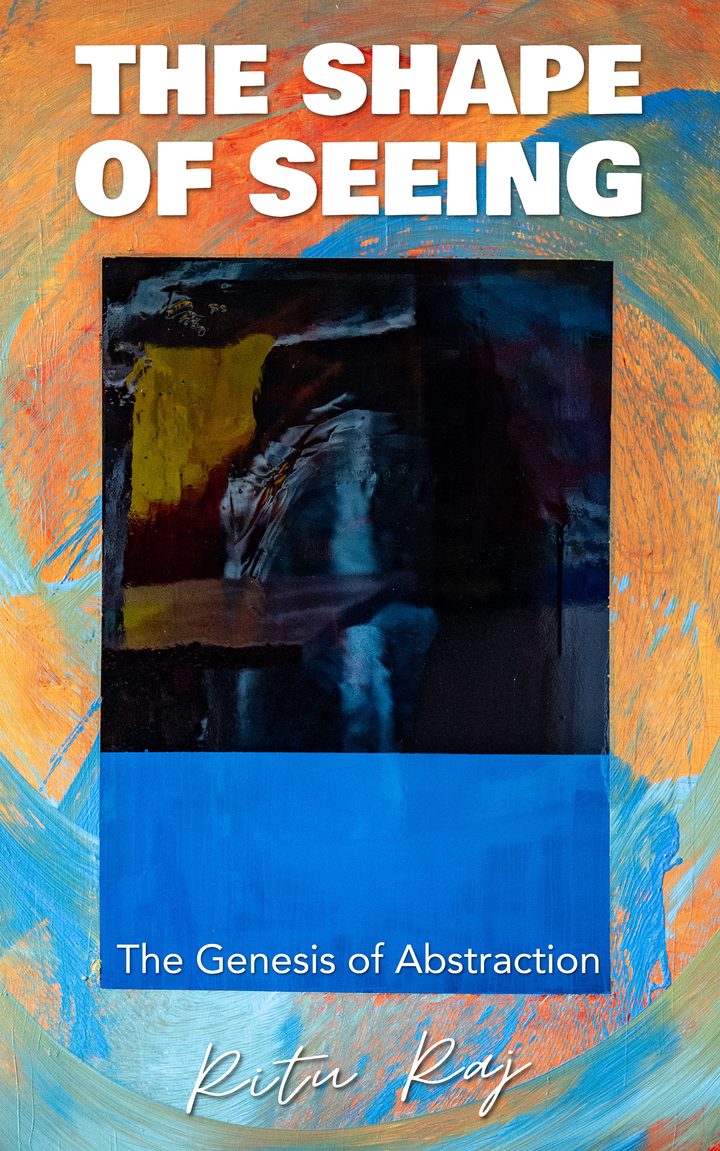
The Shape of Seeing: The Genesis of Abstraction
PUBLISHED 27 SEPTEMBER 2026
Twenty chapters on painting, perception, and how abstraction came to be.
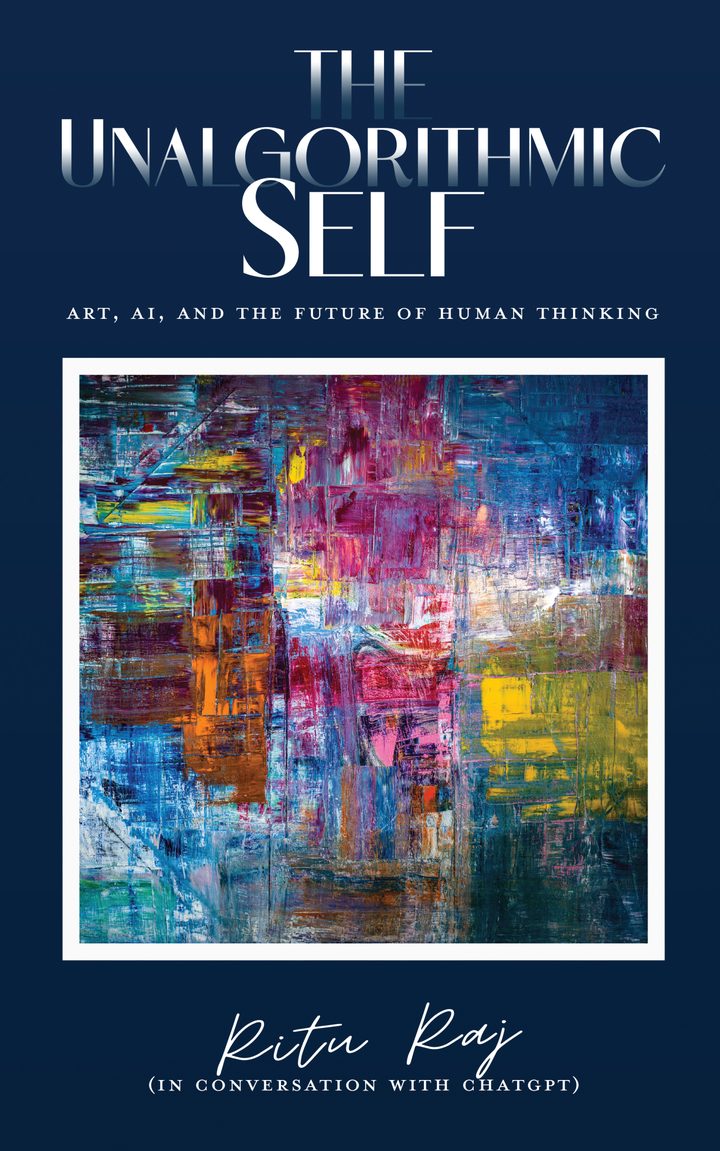
PUBLISHED 29 SEPTEMBER 2026
Thirty chapters and a Conclusion, in six parts, on what in a person does not reduce to an algorithm.
Both are published by American Real Publishing and live at rituart.com, which is where the paintings are too. This page only points there.
In the press
ArtGraph in Authority Magazine
ArtGraph, a language system for encountering abstract art, is the subject of a new interview in Authority Magazine’s Social Impact Heroes series, a conversation with Ritu Raj, the painter, author and entrepreneur who developed it.
The interview starts from a problem: most people are averse to abstraction. They feel they don’t get it, so they walk away. ArtGraph exists to turn that aversion into an encounter. It gives anyone words for what a painting does to them: six dimensions read the painting, and three read the meeting between the painting and the person looking at it. The ArtGrams it produces are free to share under Creative Commons, because a language only works if it travels.
The conversation also sets out why this matters now. In a world increasingly shaped by algorithms that hand us finished meanings, an abstract painting asks the viewer to stand still and complete it, and no two people complete it the same way.
Read the full interview on Authority Magazine →
Ritu Raj is an abstract painter, author and entrepreneur. He works from RituStudio in Phoenix, Arizona, where his signature technique, Organic Movement, lets thread take the place of the brush and makes gravity a collaborator. He has made more than 250 paintings and is represented by Jarrow & Goodman in Los Angeles. Mathematics and computer science gave him another grammar for the same question, and three decades of building companies tested it at scale: he founded Avasta and Wag Hotels and helped build SideCar and Diamond Foundry. The painting, the systems and ArtGraph, his language for abstract art, are one inquiry. He is the author of The Shape of Seeing, on how abstraction arrives, and The Unalgorithmic Self, a philosophical inquiry into what AI cannot reach.