What it is
A book about the sentence that does not exist.
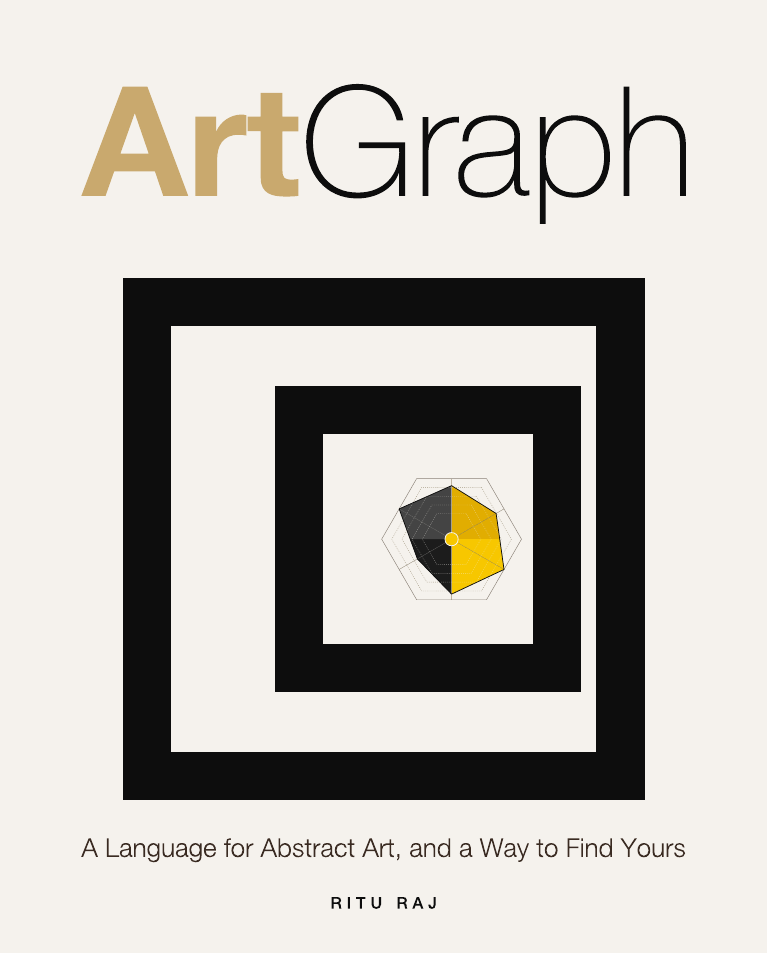
Every other kind of painting can be handed to a stranger in a sentence. A woman at a window. Horses at dusk. The sentence is the index, and the index is why the painting can be found. Abstraction has no such sentence, and so it is sorted instead by the things that survive a database — size, medium, dominant color, price — none of which is the reason anyone has ever stood still in front of one.
ArtGraph is one attempt at a missing language. Six dimensions read the painting. Three fields read the encounter between the painting and a person in a room. It is not a theory applied to art from outside. It was built in a studio, against a working catalog of 250+ paintings, by someone who had to keep being wrong about them in public.
The organising argument is about zero. Brahmagupta’s zero was not a place to arrive at or pass through; it was an abstraction invented to answer a problem, and the glyph travelled while the rules stayed in Sanskrit. This taxonomy is an invention of the same kind, and the ArtGram is the part that travels.
The shape of it
I
The problem
Four people standing in front of something they cannot say, including the author. No system yet, and no vocabulary offered.
II
The argument
Why the words are missing, whether anyone has looked for them before, and what kind of thing would have to be built. The double abstraction, and the century that encoded the object.
III
The six
Texture, Form, Color Range, Palette, Contrast, and the Abstraction Quotient. Five measured against matter; the sixth against language. One dimension fails here and is removed.
IV
The ArtGram
The six stop being a list and become one object. Notation, and why it is the part that travels. The grammar admitted as not yet existing.
V
The shapes
Thirteen outlines that recur once enough marks are made. Named regions of a continuum, and a negative result: shape does not predict what moves people.
VI
The three
Space, Transformation and Feeling. What the painting does to a person, read from both ends. The prose changes here, and it is meant to.
VII
The field
The whole catalog read as marks. What becomes visible at that scale, and the level the author reached without a vocabulary in hand.
VIII
The use
Somebody who has never heard of any of this, wanting one painting, unable to say which. The Concierge, the shoe floor, and the card they leave with.
IX
The infrastructure
The ArtGraph Engine, the method drawn rather than described, and an invitation to test whether the language survives a catalog nobody here has seen.
X
The evidence
Seven works by other hands. What viewers reported. Where a machine reading 224 paintings disagreed with the painter, and was closer to right because it knew less.
XI
The limits
What a language cannot do, where the framework was wrong, and the question left open: whether abstraction can become relational without passing through representation.
Two appendices carry the method in public: How the Catalog Was Scored, and Seven Outside the Catalog — readings of Rothko, Pollock, af Klint, Richter, Souza, Husain and Swaminathan, each stating what a photograph can and cannot carry. A third lists nine experiments that remain unresolved.
Status
The manuscript is complete at 309 pages, in eleven parts. It has no publisher and no publication date, and this page will say so until that changes.
Everything on this site is the book’s argument running in public — the paper, the dimensions, the readings, and the analysis in which the framework is caught disagreeing with itself. A reader can check the claims before the book exists, which is unusual and deliberate.
For publishers and agents
ArtGraph is a completed illustrated nonfiction manuscript at the intersection of art, perception, language and AI. 309 pages, 57 chapters in eleven parts, with a catalog of 250+ scored paintings and 42 works by other hands read on the same terms.
Proposal and sample chapters are available on request.
Two companions, now published
AMERICAN REAL PUBLISHING · 27 SEPTEMBER 2026
AMERICAN REAL PUBLISHING · 29 SEPTEMBER 2026
Both were written alongside this one, both are out, and both stand on their own. ArtGraph is the technical heart of the three: the one that names the dimensions and shows the working.
Here is what
I listened for.