A notation has exactly one requirement: that it means the same thing the second time you see it.
Why a notation at all
Brahmagupta wrote the rules for zero in Sanskrit, and the rules stayed where they were written. The glyph went everywhere.
That is the difference between a vocabulary and a notation. Abstract Dimensions is the vocabulary: six dimensions and three fields, and what each of them reads. It has to be read, in a language, by someone willing to learn it. The ArtGram is the notation, and notation is the part that travels without its author. Someone can see that one painting reaches further than another without knowing the word Contrast, without reading English, without having any idea who made either work.
So a reading gets written twice. Once in words, for anyone who wants the argument. Once as a shape, for everyone else.
Anatomy
Five parts, and each of them is a decision that could have gone another way.
- 1
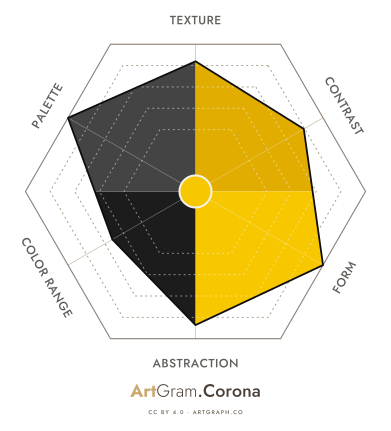
- The reference hexagon. A regular six-sided frame standing on its base, identical for every painting in the catalog. The plotted shape sits inside it, so the ArtGram is always read against the same frame rather than against itself.
- 2
- The rings. Four dotted rings, one at each whole score, with five being the reference hexagon itself — so the gap between the shape and the frame can be counted rather than estimated. No spoke ever reaches the center. A painting scoring nothing on a dimension is still present, still on a wall, still doing something to a room. A shape collapsing to a point would say otherwise, and it would be a lie.
- 3
- The palette, filling and plotting. Palette does both. It fills the shape, one opaque wedge per pigment clipped to the polygon, so the ArtGram carries color as color. The dominant color sits at the center, and when nothing governs the center is grey. And it plots as position like the others: how far one color governs, from a canvas ruled by a single color to one where several share it.
- 4
- The plotted shape. Texture at the top, then Contrast, Form, Abstraction at the base, Color Range and Palette, always in that order, always at those angles. The order is arbitrary and fixed, which is what makes the shape comparable at all.
- 5
- The base, and the lockup on it. Abstraction points straight down through the middle of the base. The name sits on the base of the reference hexagon, never the plotted shape — the plotted base tilts with every painting, the reference base is horizontal at every size. Below it the lockup reads ArtGram and the name of its shape.
Invariance
The same painting, three sizes. Nothing has been redrawn.
Every proportion is a ratio to the hexagon rather than a measurement: the lockup at a fixed fraction of the radius, the gap below the base as a fraction of the side. Which means a reading printed on a business card and the same reading painted at four feet are the same ArtGram, and a person who has learned to read one has learned to read the other.
This is also why it is generated rather than drawn. The ArtGram comes out of the catalog record by computation. Change a score and the shape follows in the same commit; there is no version of it kept by hand that could quietly come to disagree with the number printed beside it.
Reading four of them
The point of a notation is that you stop reading it and start seeing it.
Thread Witness
texture at the ceiling, color stripped away
Ferrari Aperture
form absolute, one note held
Rajasthani Ghagra
the eye refuses to settle
Ganesh in the Abstract
abstract in handling, named in a second
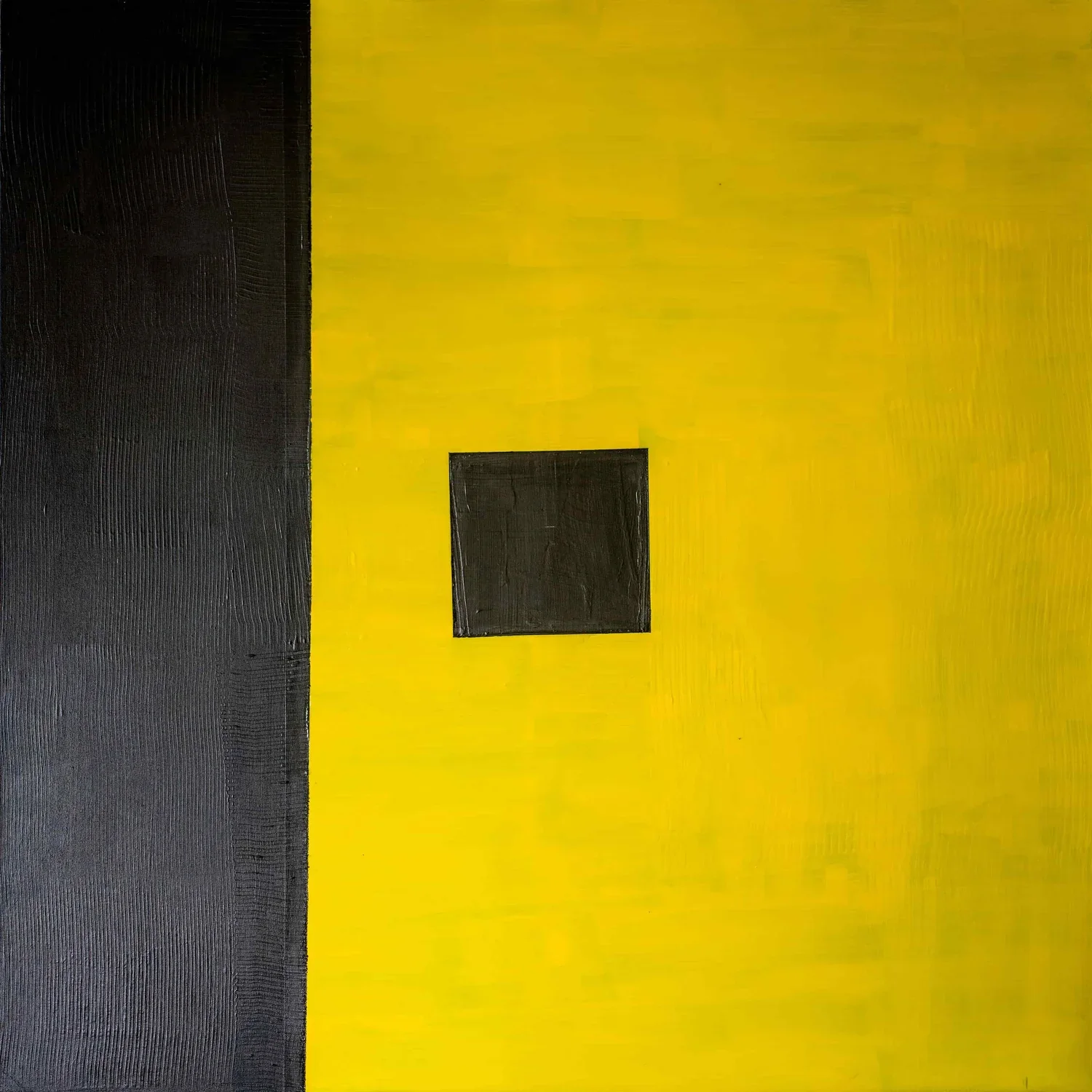
Thread Witness spikes at the top and collapses on the left: everything in the surface, nothing in the spectrum. Ferrari Aperture is nearly regular, which is what absolute form and a held palette look like together. Rajasthani Ghagra fills its frame. Ganesh in the Abstract pulls hard toward the floor on one spoke while holding elsewhere, which is the signature of a painting that is abstractly made and instantly named.
What it cannot carry
The three that read the encounter are missing from the ArtGram, and their absence is the honest part.
Space, Transformation and Feeling do not appear, because they are not properties of the painting. They arise between a work and a person in a room, and the ArtGram, drawn from a record, cannot know the room or the person. Any notation claiming to carry them would be claiming to know something it cannot.
So the ArtGram is a complete notation of one half and silent about the other. That is the seam again: six of the painting, three of the encounter, and only one of those halves can be written down in advance.
The thirteen shapes
Look at enough ArtGrams and something appears that no one designed. The figures begin to repeat. Set the color aside, let each reading simply reach or hold back, and the painting’s own figure resolves into one of a small number of Shapes. The ArtGram and the Shape are the same painting seen in full and seen in outline. This is why every ArtGram is unique and yet never alone: like a landscape, it has a lay of the land beyond its color, and paintings that share a Shape share something of that land. Thirteen have emerged from my catalogue. A fourteenth would mean the rule itself has to grow, and paintings from other hands may one day ask for that.
Questions
- What is an ArtGram?
- The painting's reading in visual form. The six dimensions position the corners of a hexagon — texture, contrast, form, how far the work has travelled from anything a stranger could name, colour range and palette. Palette also fills the shape, one band per pigment. It is a function rather than a drawing. The same record produces the same ArtGram, every time, at any size, on any surface.
- Does it replace what a catalogue already records?
- No, and it could not. A catalogue records what a work is: title, year, medium, size, who made it, where it has hung. An ArtGram records how it behaves — what a person meets when they stand in front of it. Neither answers the other's question, and a collection that has one still needs the other. The ArtGram sits beside the record, not in place of it.
- Where does the ArtGram sit between a painting and a person?
- The language reads the painting. The ArtGram is that reading made into a single object. And the person meets the ArtGram rather than the reading, which is the whole point of having one — a paragraph about a painting has to be read, agreed with, and remembered, where a shape is recognised. Two people can point at the same ArtGram without first agreeing on what any of the words mean.
- Where did the thirteen shapes come from?
- Nobody designed them. Score enough paintings and certain silhouettes keep recurring, and after two hundred or so they became recognisable enough to name. They are named regions of a continuum rather than categories with edges: the thresholds between them are decisions, and a work at the edge of one sits close to the next. Move a threshold and some paintings change shape without anything about the painting having changed. That sounds like a weakness. It is also what most words are.
- Why call it a language rather than a chart?
- Because describing an abstract painting in words turns it representational again — of your description. Say striking, and the word now stands where the painting was. So the units here are not words. There is a unit, the ArtGram. There is a vocabulary, the thirteen shapes. What there is not yet is a grammar, because a grammar is rules for combination and what exists between one ArtGram and another today is only similarity and difference. The longer argument is here.
The rules stay where
they were written.
The glyph travels.
Ritu Raj — the dimensions this ArtGram plots are set out in Abstract Dimensions, and the argument behind them in Taxonomy of abstraction. ArtGram is a term of this framework: use it freely, attribute it here. So is every ArtGram. Every ArtGram published on this site is released under CC BY 4.0 — put them in a catalogue, a lecture, a paper, a wall text, adapt them where they are more useful adapted, and say where they came from. The paintings they read are not included. Those stay where they are.