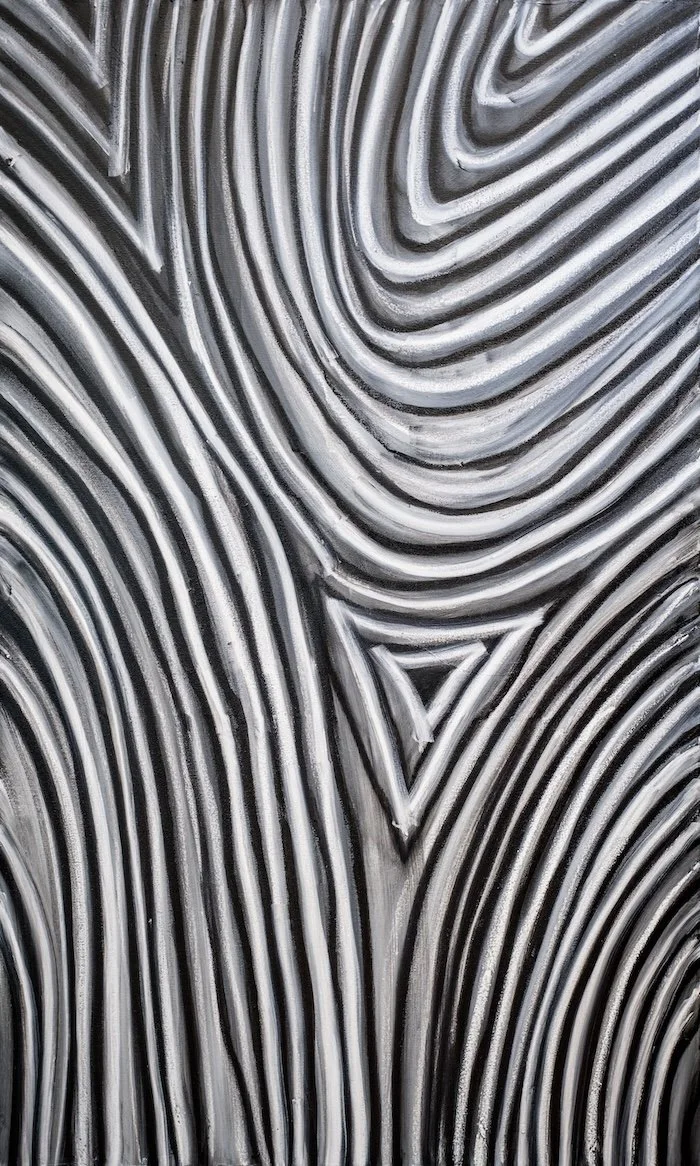
Antelope Canyon holds its subject at the threshold of dissolution, not quite surrendering the canyon's slot-forms to pure abstraction, not quite insisting on them as document. The black-and-white palette refuses the ochres and burnt siennas that made this location a cliché of American landscape photography, and in that refusal the painting earns its right to the subject again.
Form scores a 3, meaning geometry presses forward with intention; Mood at 3 reads as measured brightness, neither elegiac nor celebratory, a register that suits stone's indifference rather than a tourist's rapture. Together they produce a structural solemnity that the Abstraction Quotient of 1.5 clarifies: something recognizable survives, but only just, which is precisely where the painting chooses to live.
The risk here is considerable. Antelope Canyon is among the most reproduced geological sites on earth, and monochrome alone cannot neutralize familiarity. What saves the work is its commitment to form over atmosphere. Against the broader catalog, this piece occupies a rare position: it is neither document nor reverie, which makes it accountable to the standards of both.
Awe
swallowed whole ancient pressure time made visible breath held
STANDING THERE
The chest opens and empties at once, as if the body recognizes it has been shaped by the same forces that carved this place.
WHAT LINGERS
The sense that you have always been inside something vast and indifferent and beautiful, and somehow that is enough.
WHO IT FINDS
The truth that you are not separate from geological time but made of the same patient, relentless becoming.
Where it lives
- LIGHT
- Any lighting — monochrome palette is lighting-agnostic
- MINIMUM CEILING
- 9 ft
- MINIMUM WALL
- 8 ft
- DAYLIGHT
- Monochrome palette works anywhere — most flexible collection