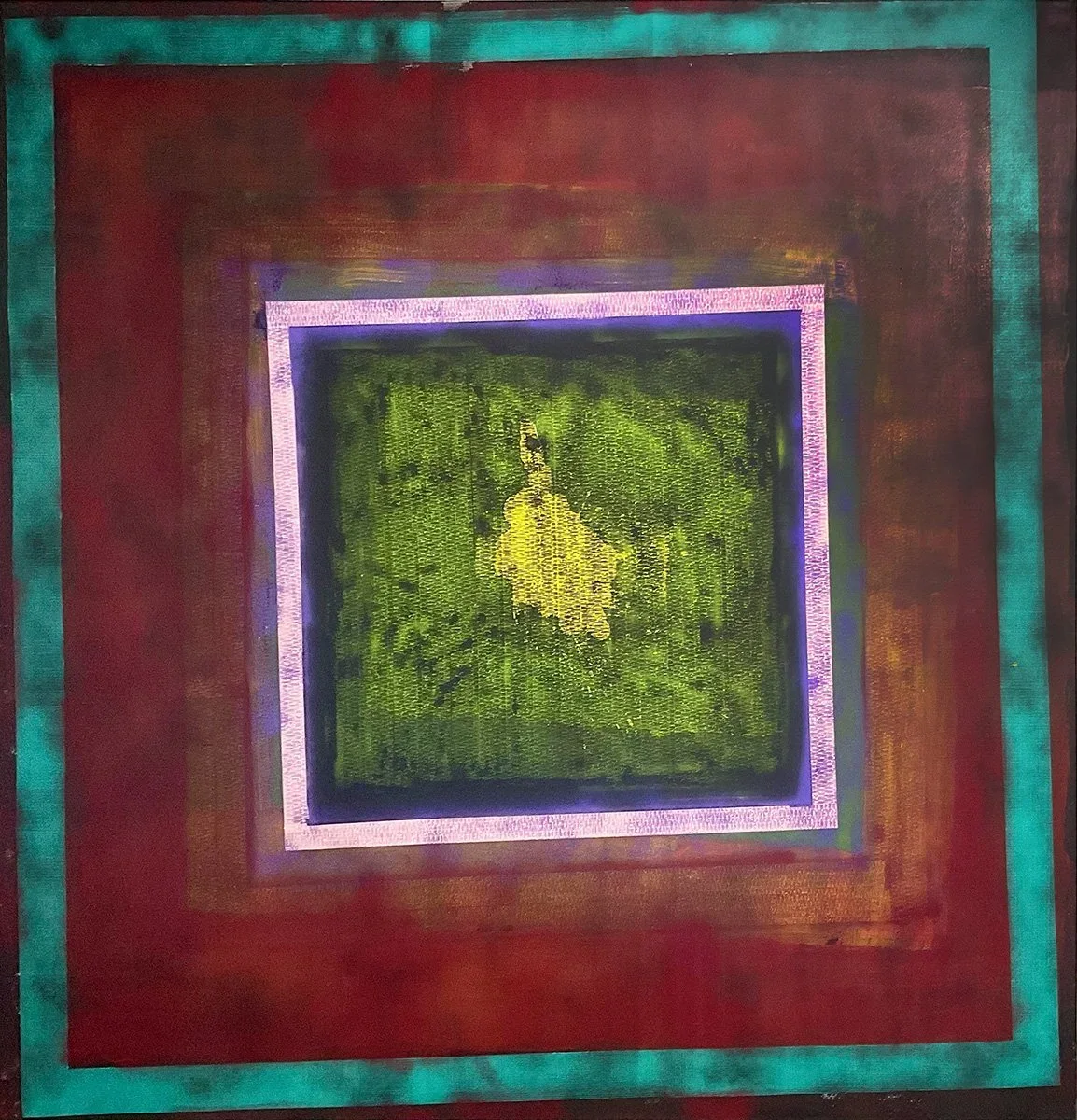
Biosphere in Flux holds itself in a condition of permanent unsettlement, neither arriving at legibility nor abandoning it entirely. Its seven-and-a-half-foot square does not frame a world so much as approximate one: sand and teal and steel blue and moss green pressed into proximity, the surface sustaining tension between organization and dissolution.
The painting earns its Abstraction Quotient of 3.5 honestly, because recognizability flickers here without resolving, and the score names exactly that threshold. What makes this reading difficult is how form and color range pull against each other: form has moved entirely to five, to pure structure without object, yet the palette retains enough tonal variation, a four, to suggest atmosphere, climate, biological gradation. These two dimensions create the paradox at the work's core, a painting that describes ecological systems while refusing to picture them.
Against the rest of the Ephemeral Atmosphere collection, this piece carries the largest gamble. Its mood registers near somber, a one, and that is a cost willingly paid: reverence here is not warmth but weight. The work refuses resolution and refuses beauty as consolation, insisting instead that aliveness looks like precarity. That refusal is its argument.
Reverence
held breath dissolving edges cool vastness trembling stillness
STANDING THERE
The body becomes small and permeable, as if the boundary between skin and air has quietly negotiated a truce without asking permission.
WHAT LINGERS
The feeling that you were always part of something enormous and indifferent and beautiful, and you simply forgot until now.
WHO IT FINDS
It finds the part of me that knows I am temporary and is, against all reason, grateful for it.
Where it lives
- LIGHT
- Natural light transforms this work — morning and evening light read differently
- MINIMUM CEILING
- 10 ft
- MINIMUM WALL
- 10 ft
- DAYLIGHT
- Works beautifully near glass — the palette was built for cha