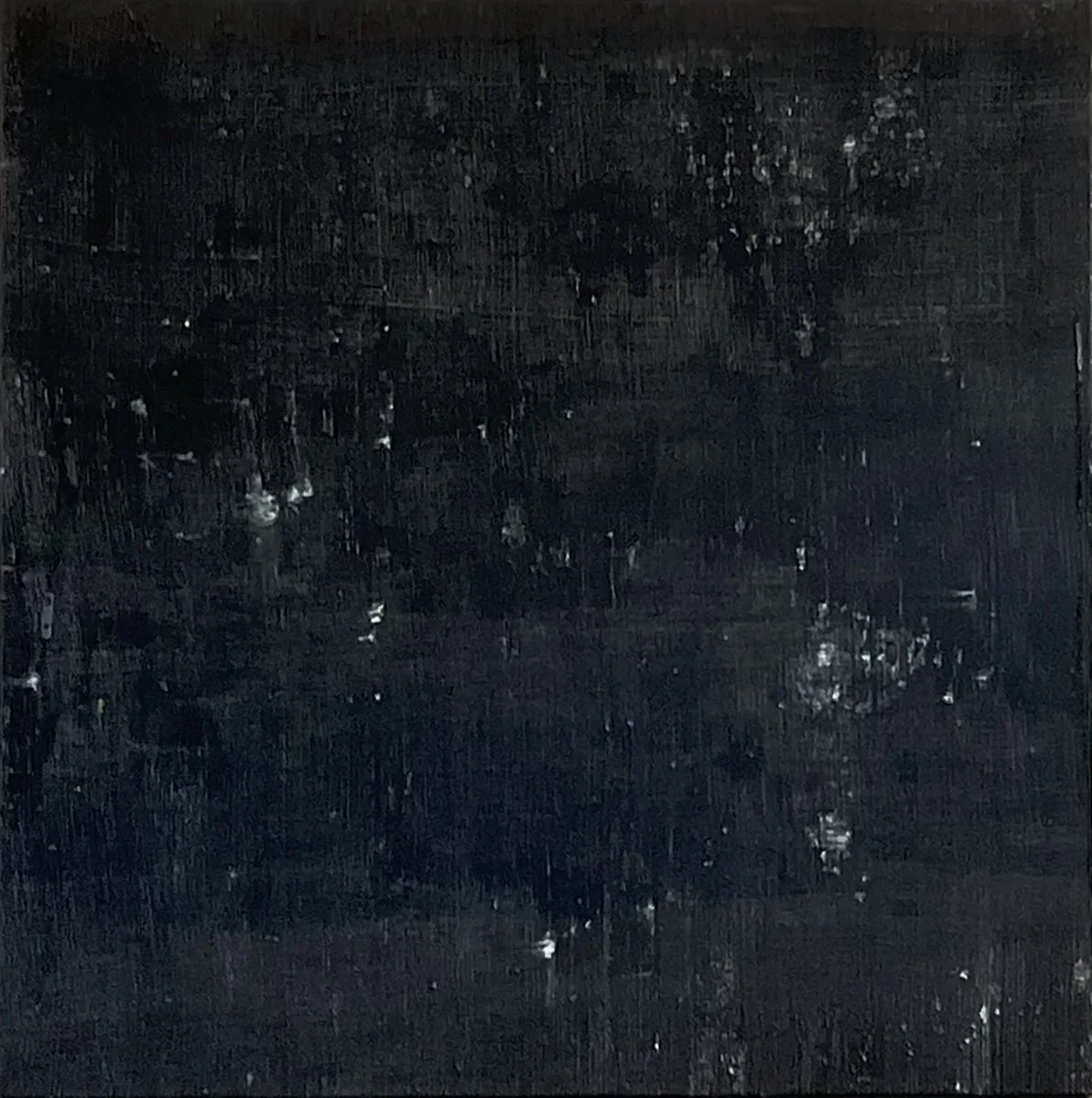
Black Square holds its ground without explanation. At five feet on each side, the canvas does not illustrate darkness; it enacts a proposition about it. The palette, matte black and graphite and charcoal, refuses the comfort of a single, unified void, and the surface carries enough textural differentiation that the eye keeps working, keeps finding slight distinctions within what first presents as total.
What the work refuses, most fundamentally, is the legible. An Abstraction Quotient of 5 is a terminal reading: nothing recognizable as shape, form, or subject survives. That total distance from the representational makes the interaction between Texture 3 and Form 1 consequential in a specific way. High surface articulation with nearly dissolved form means the viewer encounters differentiation without reference, variation without anchor, presence without name.
The risk is obvious and serious: Malevich got there first, in 1915, and declared it a terminus. Raj's wager is that the gesture retains force when reoriented, when the square becomes a beginning rather than an endpoint, a question rather than a closing statement. Whether the catalog bears that wager out across the whole series is the better question, and Black Square sets the terms aggressively.
Reverence
void holding everything edges breathing silence with weight darkness that sees you
STANDING THERE
The body goes still and slightly hollow, as if something vast just turned its attention toward you.
WHAT LINGERS
Long after you leave, the square stays open somewhere behind your eyes, asking nothing and demanding everything.
WHO IT FINDS
It finds the part of me that suspects emptiness is not absence but the most honest kind of fullness.
Where it lives
- LIGHT
- Low ambient light amplifies luminous passages — dark-wall installation ideal
- MINIMUM CEILING
- 9 ft
- MINIMUM WALL
- 8 ft
- DAYLIGHT
- Best on solid interior wall away from competing natural ligh