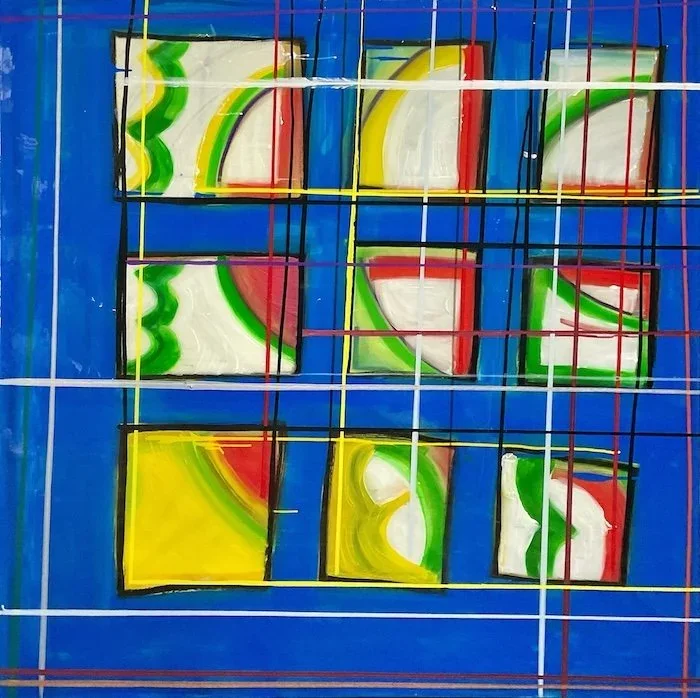
Crooked Windows holds its title as both description and argument: the rectangular field refuses to resolve into stable geometry, and whatever window logic the composition inherits, it has already bent past the point of allegiance to architecture.
Form scores high at 4, approaching the catalog's upper register of structural dissolution, yet Color Range matches it at 4, which means the palette, Storm Gray against Moss Green and Ochre and Quiet Teal, carries load that might otherwise fall to legible shape. The two dimensions pull in concert: color becomes the syntax when form has resigned its duty to name things. That the Abstraction Quotient reads only 3 is the telling fact, close enough to the recognizable that the window ghost still haunts the picture, refusing to disappear entirely.
The risk Crooked Windows takes is refusing the comfort of full dissolution. A harder abstraction would release the viewer from the frame metaphor; this one keeps it audible. Within the Abstract Inquiry collection, that restraint reads as a deliberate wager, one the painting wins conditionally, provided the viewer does not mistake retention of the motif for timidity.
Restlessness
warped grids inherited angles glass that bends
STANDING THERE
Something in the structure refuses to settle, like a room you've lived in so long you stopped noticing the floor tilts.
WHAT LINGERS
The distortion isn't damage — it's the shape the mind actually grew into, and now you can't unsee it.
WHO IT FINDS
Somewhere between the crooked lines lives the quiet suspicion that what was handed to you was never meant to hold you straight.
Where it lives
- LIGHT
- Natural light preferred — oil layers shift through the day
- MINIMUM CEILING
- 9 ft
- MINIMUM WALL
- 8 ft
- DAYLIGHT
- Natural light from nearby glass enhances layering — flexible