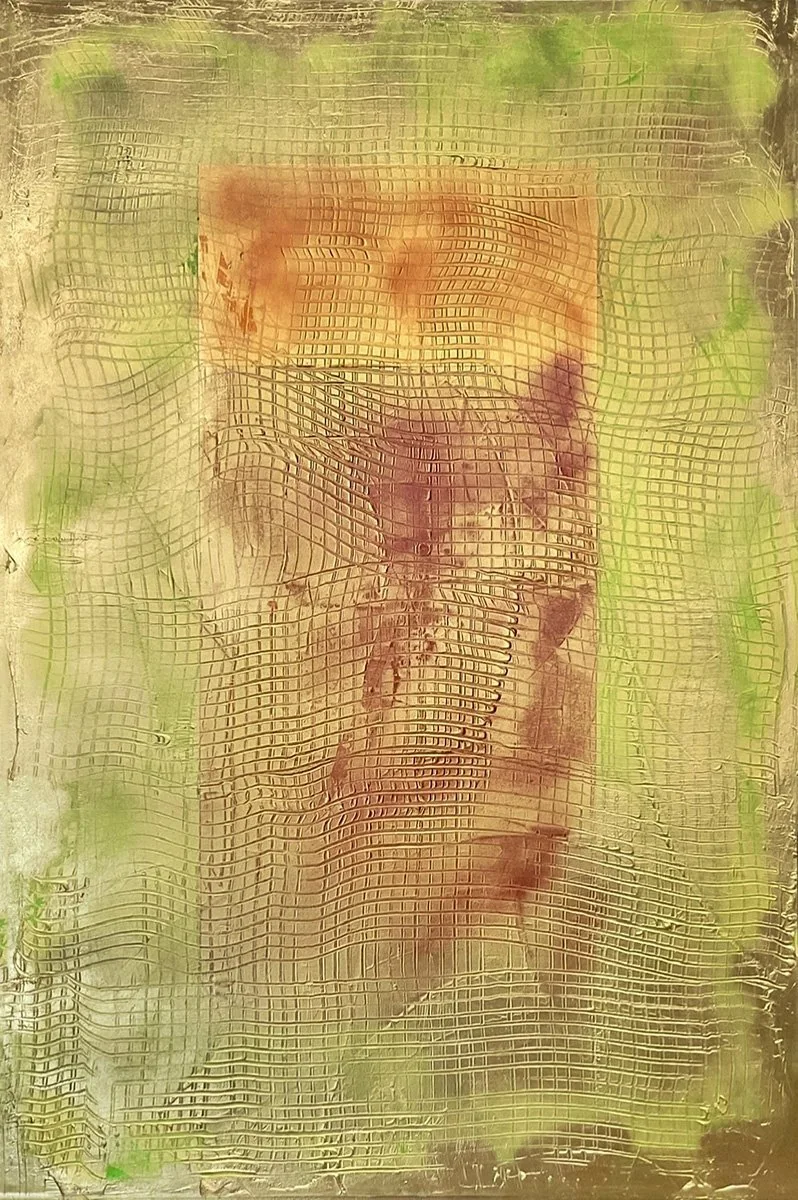
Golden Shroud occupies its six-by-four-foot vertical field as a work that withholds rather than declares. The gold does not illuminate a subject; it becomes the subject, dense and directional, operating as surface and symbol simultaneously. Ash gray and tarnished white persist at the edges or beneath, not as shadows but as what the gold has decided to address. The painting's scale is not incidental: largeness here is a formal argument, insisting that concealment requires room.
At an Abstraction Quotient of 4.5, the work sits close enough to total abstraction that no object survives to be named, yet Texture 5 gives the surface a material weight that keeps it from becoming purely atmospheric. Read against Color Range 3, that density becomes purposeful restraint: the palette is narrow, metallic, almost liturgical, and Contrast 2 is not warmth withheld but all that luminosity compressed into a limited chromatic register.
What Golden Shroud risks is a kind of seriousness that forecloses irony entirely, a devotional register that can tip from reverence into solemnity. It refuses ornamentation even while using gold, which is the more difficult choice. Within the Abstract Inquiry collection it occupies an authoritative position, less exploratory than certain other works, more committed to a single argument. That commitment is the cost, and also the source of whatever authority the painting earns.
Reverence
warm burial sacred threshold held breath
STANDING THERE
You stand before something wrapped rather than revealed, as if the gold is not showing you a thing but keeping it.
WHAT LINGERS
The glow stays in your chest long after your eyes have moved, like candlelight remembered rather than seen.
WHO IT FINDS
Underneath all that tenderness of covering, grief finds itself honored rather than hidden.
Where it lives
- LIGHT
- Natural light preferred — oil layers shift through the day
- MINIMUM CEILING
- 9 ft
- MINIMUM WALL
- 8 ft
- DAYLIGHT
- Natural light from nearby glass enhances layering — flexible