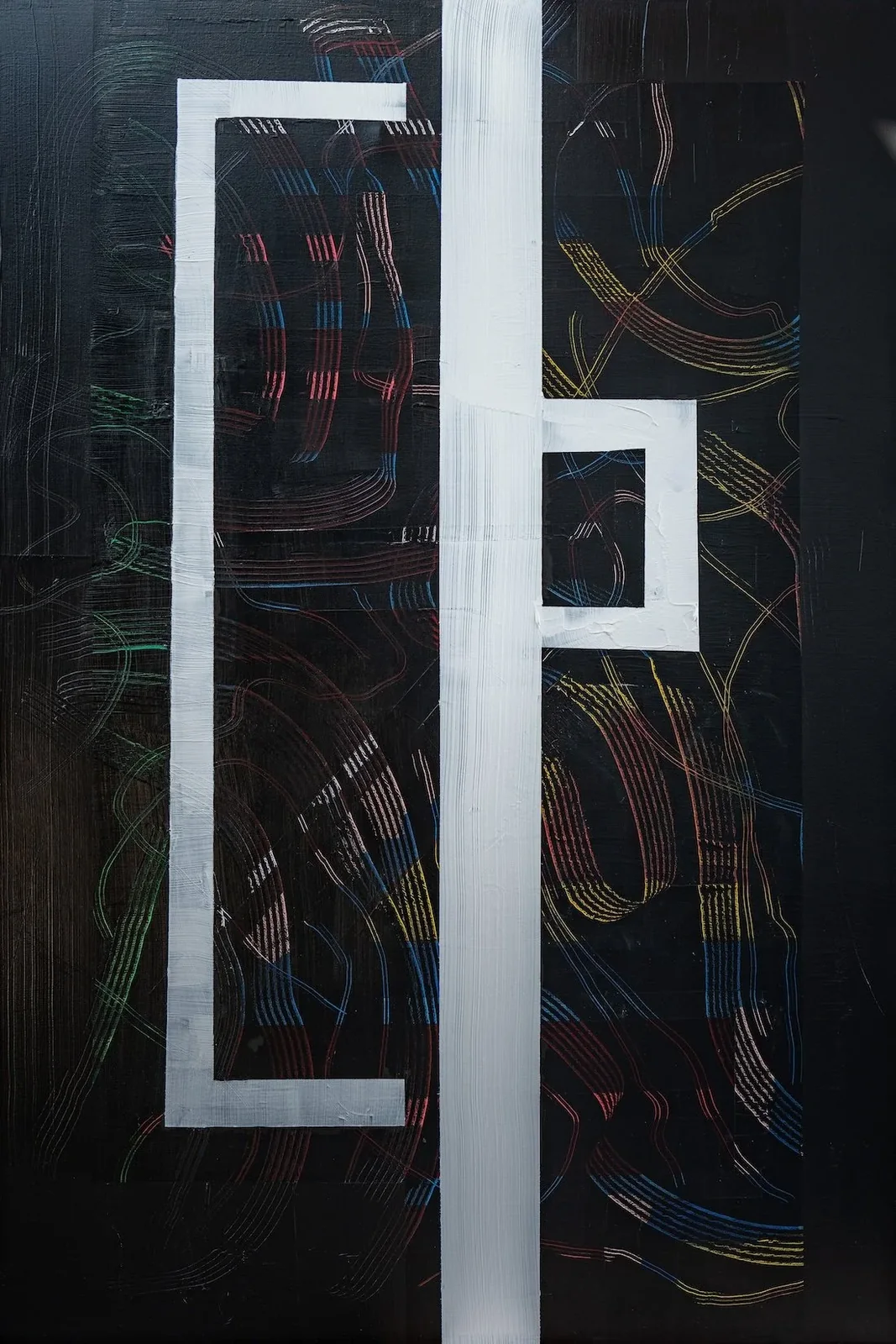
The Hanger in Negative Space holds its subject at the threshold where recognition persists but barely: a hanger, stripped of clothing, stripped of purpose, present only as silhouette and the field it displaces.
That threshold is precisely where the taxonomy becomes useful. The surface carries Texture and Form both at four, which means the paint itself is doing structural work, building an object-ness that anchors the composition, and the Abstraction Quotient sits at three, meaning the hanger survives as nameable thing just long enough to make its isolation legible before the surrounding void begins to compete with it for primacy. Meanwhile the Color Range of two, set against metallic thread worked into matte black, refuses ornament while still admitting a narrow, cold shimmer, a refusal that keeps the palette honest to the Mood score's near-floor gravity.
The risk the painting accepts is sentimentality, the domestic object carrying too much symbolic freight too easily. What it refuses is resolution: nothing in the composition explains the hanger or redeems it. Against the broader catalog, this is among the works that trust negative space to carry genuine weight rather than decorative emptiness, and that trust costs the painter the comfort of a legible emotional conclusion.
Solitude
hollow geometry waiting quietly present
STANDING THERE
The hanger stands in its own negative space, stripped of everything it was meant to carry, existing simply as structure.
WHAT LINGERS
There is something quietly devastating about a thing designed entirely for another that remains alone, still holding its shape.
WHO IT FINDS
In the absence of what should be there, the eye discovers that the support itself has always had a kind of dignified beauty.
Where it lives
- LIGHT
- Any lighting — monochrome palette is lighting-agnostic
- MINIMUM CEILING
- 9 ft
- MINIMUM WALL
- 8 ft
- DAYLIGHT
- Monochrome palette works anywhere — most flexible collection