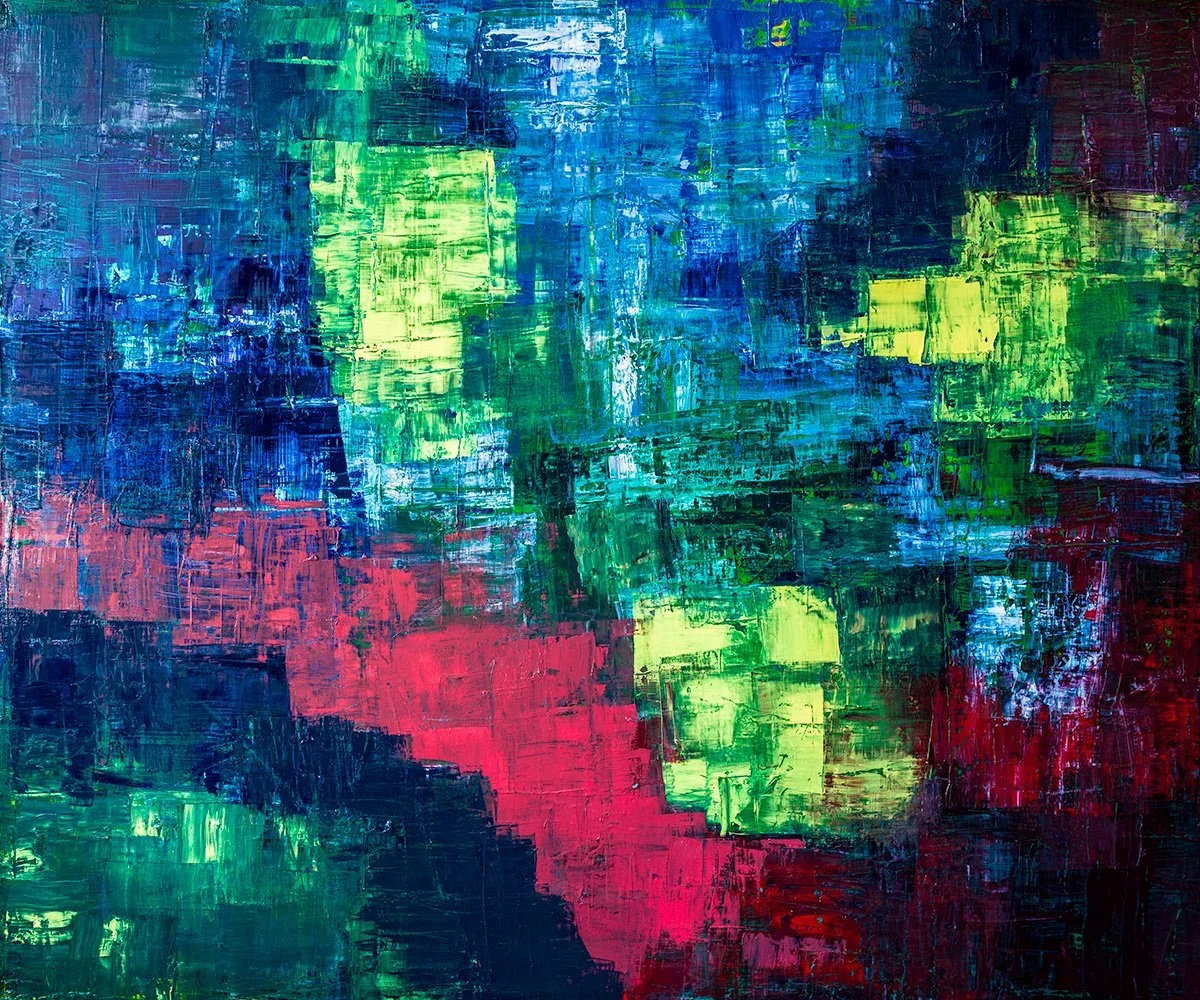
Fragments of a Hidden Past is built in rectangles rather than fields. Passages of blue and green stack and overlap across the whole surface, each one dragged vertically over horizontal blocks so it reads as slightly translucent — layers showing through layers rather than sitting beside one another. The effect is architectural before it is atmospheric: a wall of lit openings, or a screen with something behind it.
The color range is 5, a level only a handful of works in the catalog reach. Cobalt through viridian to chartreuse in the upper two thirds, then a magenta mass entering at the lower left and answering itself in deep crimson down the right edge. Yellow-green appears at three separate points, which is what stops the composition resolving into a cool half and a warm one. Texture and form both sit at 4 — worked enough to hold light, structured enough to hold the eye — and at an abstraction quotient of 4 the grid stays legible as structure without ever becoming a depicted thing.
Underneath is an acrylic canvas that never left the back room: no title, no record, never photographed. The painting's title takes that literally. These are fragments, and the past they belong to is not partially recoverable but wholly gone — which is the difference between this and the other transformed works in the studio. Sindoor Field and Sea Change each name what is buried. This one can only say that something is.
Longing
lit distant layered unreachable warm-behind-cool
STANDING THERE
The chest tightens slightly, the way it does looking at lit windows from the street. Everything is visible and none of it is yours.
WHAT LINGERS
The warmth coming through from behind the cool, and the sense that it belongs to something you arrived too late for.
WHO IT FINDS
It finds the part of me that is still looking for a room I have already left.
Where it lives
- LIGHT
- Even light. Directional light flattens the layering, which is where the depth lives.
- MINIMUM CEILING
- 9 ft
- MINIMUM WALL
- 8 ft
- DAYLIGHT
- Cool-dominant, so it holds steady through Arizona daylight rather than shifting the way warm work does