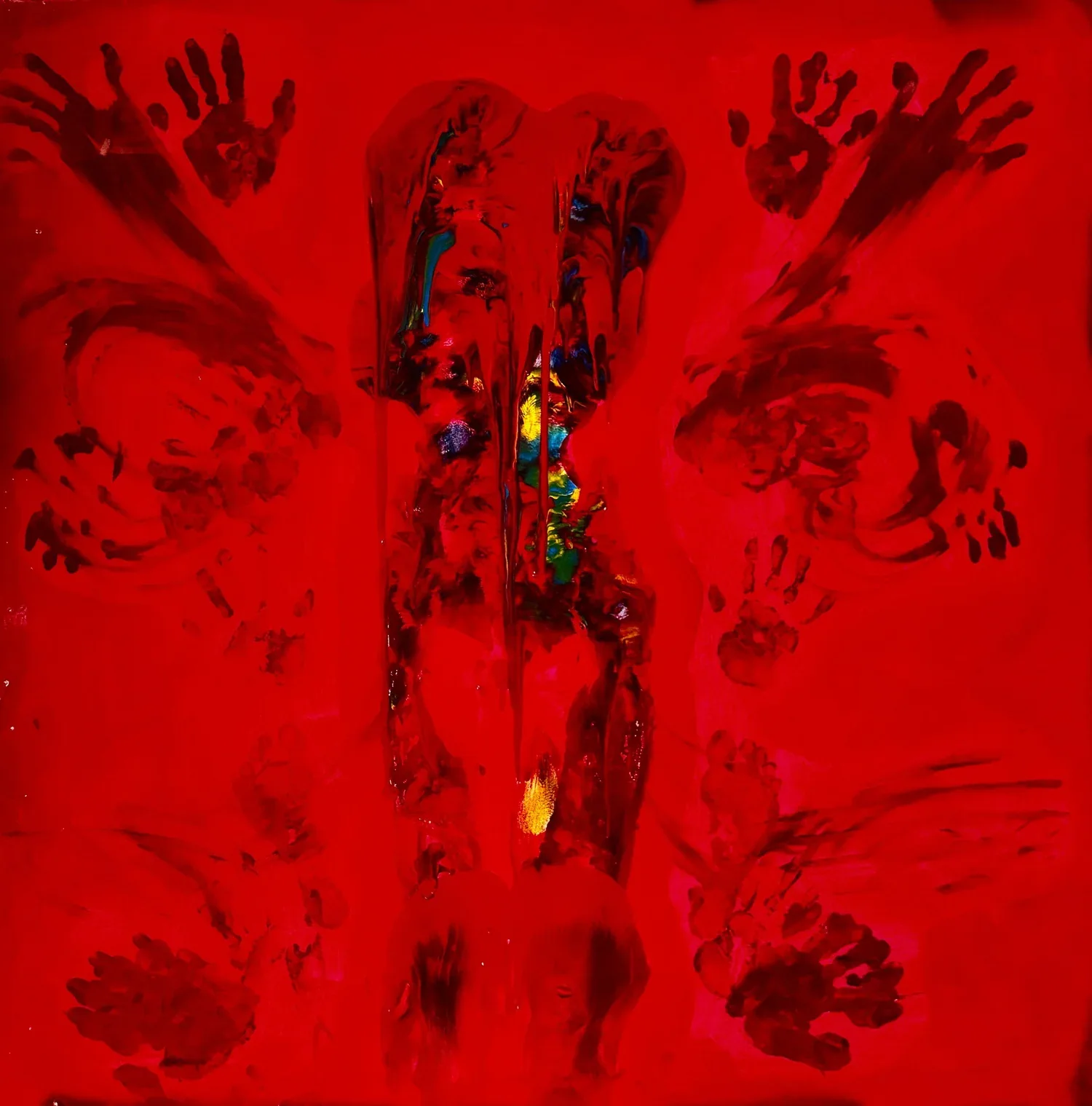
Human Print holds its subject at the threshold of legibility, where a mark is still recognizable as a mark but no longer traceable to a decision. The surface carries something that reads as evidence without naming its source. Warmth accumulates not as illumination but as residue, and the composition resists any single point of origin, distributing attention across a field that has already been passed through.
The surface maintains this pressure partly through what the taxonomy confirms: an Abstraction Quotient of 4 keeps the painting just short of pure field, close enough to figuration that the word print still carries weight. Texture at 4 and Color Range at 3 work together to do the same work differently, one insisting on materiality while the other keeps the palette narrow enough to feel like a single atmospheric event rather than a composition of chosen hues.
The risk here is sentiment. Longing is a generous emotion to assign a canvas, and the catalog's own themes, trace, residue, passed-through presence, ask a great deal of paint at this scale. What the painting refuses is resolution, and that refusal is also its cost: it asks to be believed as evidence without supplying a crime.
Longing
ghost pressed into stillness
STANDING THERE
She stands before what remains after someone has moved through air and left themselves behind without meaning to.
WHAT LINGERS
The cool light holds the impression like a breath held too long, neither releasing nor letting go.
WHO IT FINDS
In the residue of presence she finds that absence can be more tender than touch.
Where it lives
- LIGHT
- Natural light transforms this work — morning and evening light read differently
- MINIMUM CEILING
- 8 ft
- MINIMUM WALL
- 5 ft
- DAYLIGHT
- Works beautifully near glass — the palette was built for cha