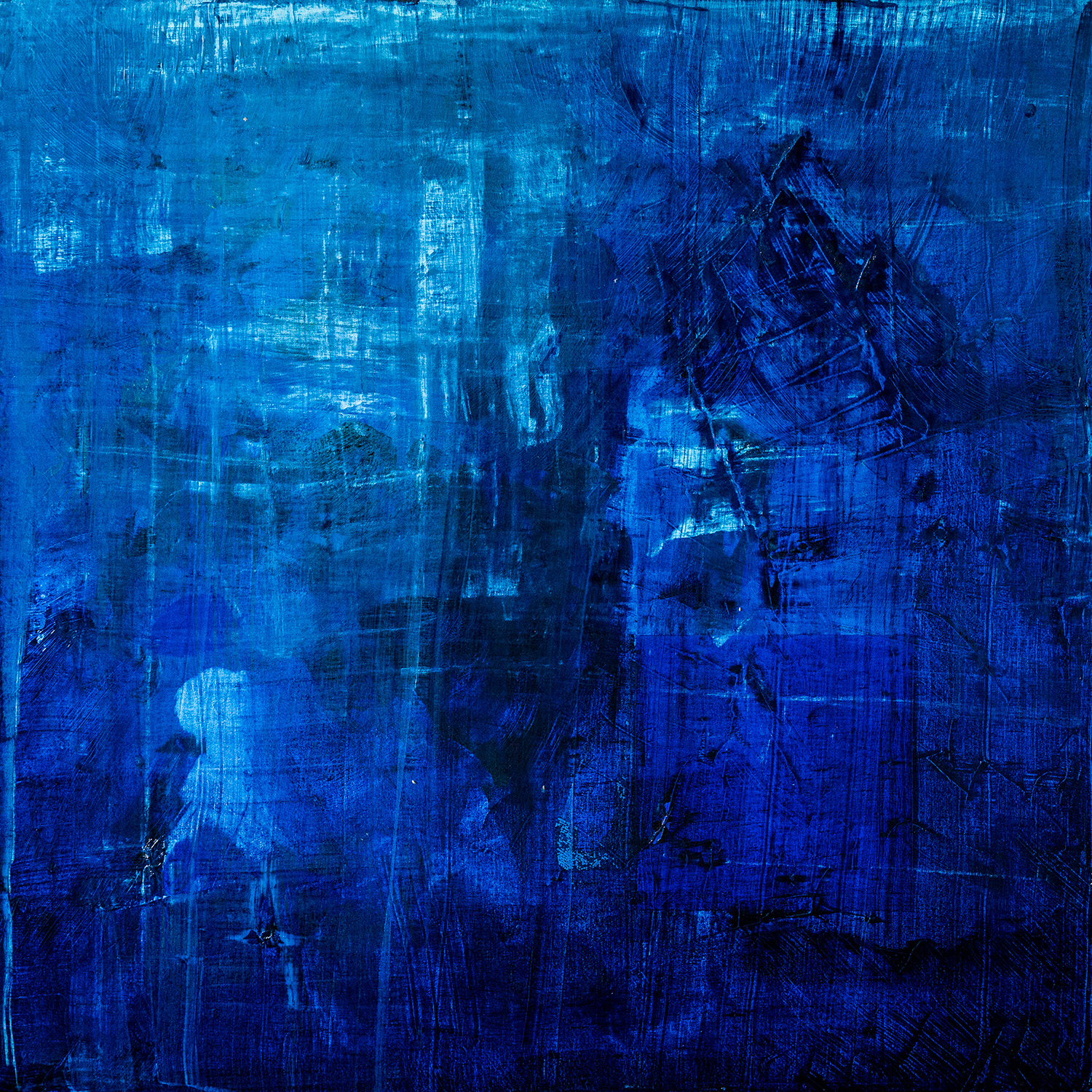
Jheel is the most extreme pairing of scores in the recent group: texture at 5 and form at 1, which is to say the painting has a surface and nothing else. There is no edge in it. Every division — and there are several, the luminous upper left, the dragged central column, the massed dark on the right — is produced by how the paint was pulled rather than by anything drawn. This is the condition the specification warns about in reverse: a work with no straight edge is a work the ArtGram's hard-edged pentagon sits awkwardly against, and placement of the mark on this painting should be considered rather than assumed.
The contrast reading of 4.3 is the number that surprises. Measured across the canvas the pigment luminance spans 49, from an ink indigo at the lower right that is effectively black to a cerulean at the upper left that is nearly open sky. That is a wider range than Odhni carries, despite Odhni looking like the high-contrast painting of the pair. The colour range stays at 2 — a hue spread of thirteen degrees, still one family — so the whole dramatic reach of the work is achieved within a single blue by value alone. That is the technical claim the painting makes and it makes it convincingly.
Underneath is Abstraction in Blue, a 2021 acrylic from Geometric Splendor, and the transformation has gone the opposite direction from Odhni's: where that one buried a geometric source under a covering field, this one dissolved a geometric source into weather. Nothing rectilinear survives. Worth flagging at the collection level rather than the painting level — this is now the second blue monochrome oil transformation of 2026, alongside Neelkanth, and the two will compete for the same query in the Concierge and for the same wall in a collector's mind. They are not similar paintings: Neelkanth is held, incised and low in contrast, Jheel is loose, scraped and wide. But the catalogue metadata will not carry that distinction on its own, and the copy for both should be written knowing the other exists.
Reverence
witnessed without being seen held ancient thread quiet accounting
STANDING THERE
the chest goes still and the feet feel rooted to the floor as if the painting is taking attendance
WHAT LINGERS
that the darkest part is still blue, and that you have to keep looking to be sure of it.
WHO IT FINDS
the part of me that has always suspected my life is being quietly recorded by something I cannot name
Where it lives
- LIGHT
- This painting needs more light than its temperature suggests. Under dim or warm-only illumination the right third collapses into a single black mass and the depth is lost. Even, reasonably bright light keeps the near-black readable as blue, which is the whole point of it.
- MINIMUM CEILING
- 8 ft
- MINIMUM WALL
- 5 ft
- DAYLIGHT
- Cool-dominant and low in warm content, so it holds steady through Arizona daylight rather than shifting with it. The risk is the opposite of Odhni's: strong direct sun flattens the dark passages rather than intensifying them.