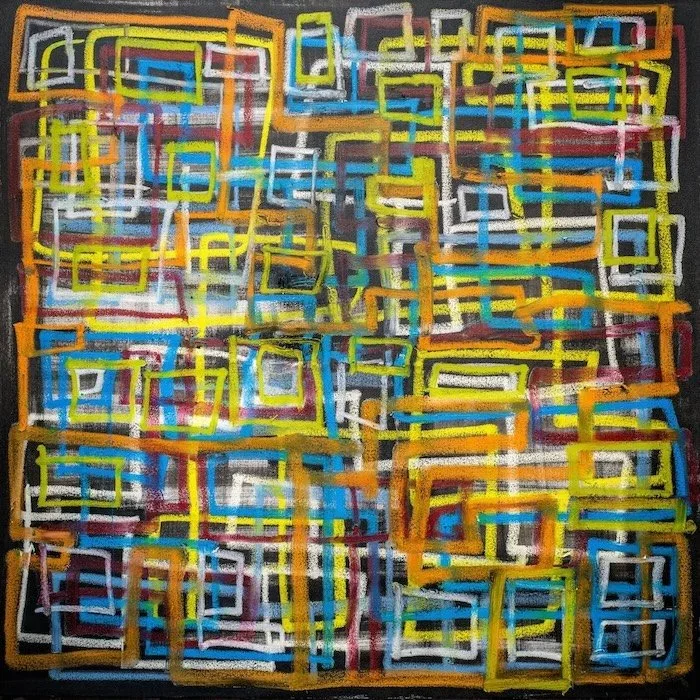
Jigsaw of Fragmented Space holds its four-foot-square field in a state of deliberate suspension, cobalt blue and emerald pressing against saffron and gold along edges that suggest adjacency without committing to union. The canvas operates less as a surface than as a proposition: that assembly and disassembly can coexist without resolving into either.
At an Abstraction Quotient of 1 the fragments stay fragments. Nothing here has dissolved past recognition, and the painting depends on that: you can see the pieces, see that they nearly fit, and see exactly where they fail to. Form at 3 holds them legible enough to be read as parts of something rather than marks on a surface, and Color Range at 3 spans cobalt to saffron to emerald so no single hue can anchor the eye and settle the question. Texture at 2 keeps the surface quiet while the shapes do the arguing. Restlessness is not imposed on the work. It is structural.
What the painting risks is the very coherence it claims. Fragmentation as thesis can become its own closure, a formal argument so complete it forecloses doubt. Against the more open-ended works in the Abstract Inquiry collection, this one pays a price for its conceptual tidiness, the idea of incompleteness nearly too well resolved.
Restlessness
fractured edges restless assembly incomplete
STANDING THERE
You stand before something that refuses to resolve, pieces almost connecting but perpetually mid-reach.
WHAT LINGERS
The eye keeps moving, searching for the corner piece that will finally make everything settle, but the painting knows there is no corner piece.
WHO IT FINDS
Somewhere inside the fragmentation lives an honest portrait of a mind during its most truthful moments.
Where it lives
- LIGHT
- Natural light preferred — oil layers shift through the day
- MINIMUM CEILING
- 8 ft
- MINIMUM WALL
- 5 ft
- DAYLIGHT
- Natural light from nearby glass enhances layering — flexible