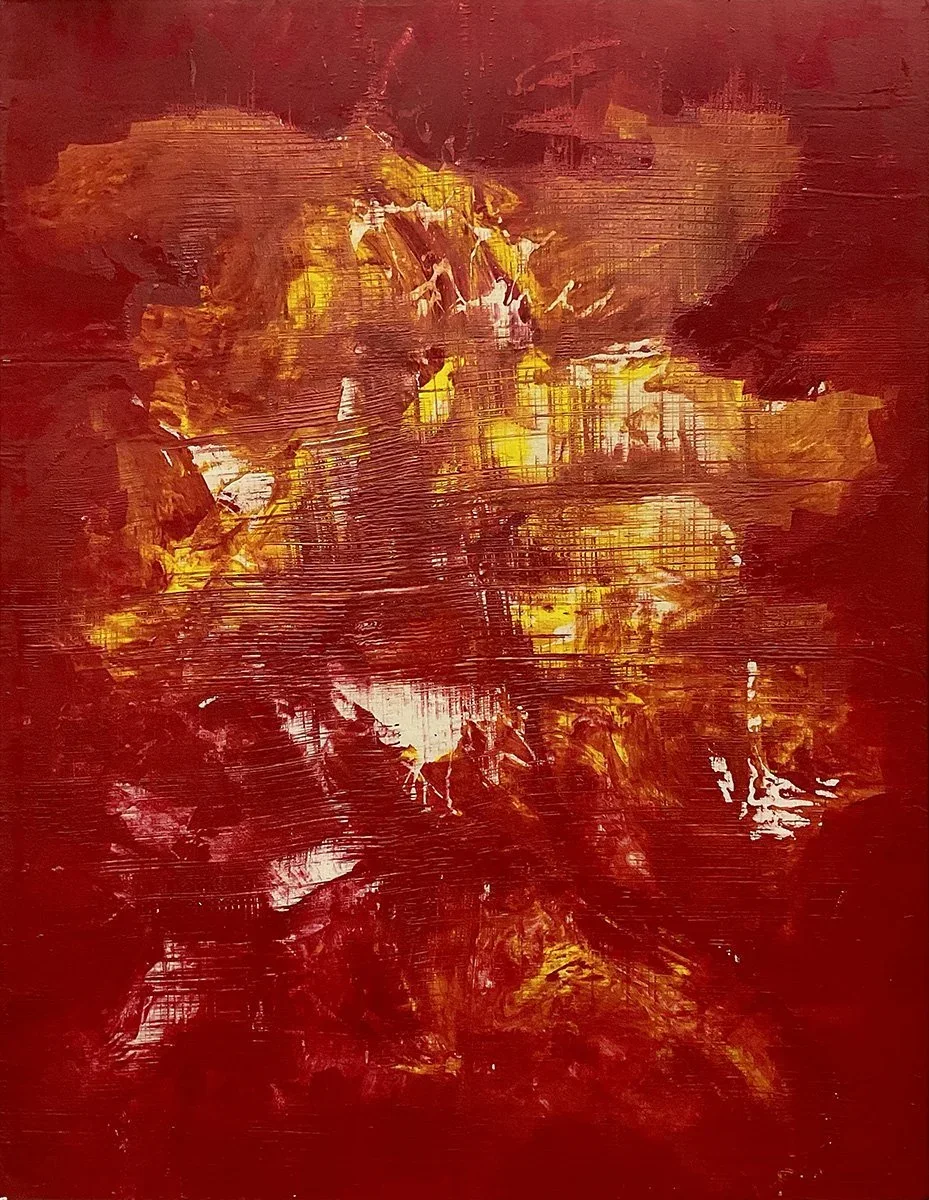
Red Planet as Abstract Mars holds its title like a hypothesis, not a label. The planetary reference survives in color and scale before it survives in form: seven and a half feet of rusty red and burnt orange that asks to be read cosmically before it asks to be read abstractly. The canvas does not illustrate Mars so much as occupy its frequency.
The Abstraction Quotient is 1.5, which means the subject is present but loosening. At that position on the scale, the tension between recognition and dissolution becomes the primary structural event. Texture at 4 and Color Range at 3 work together here to hold what Form, sitting lower at 2, is already releasing: the ochre and burnt orange build a surface memory of something planetary, something we know by reputation rather than by sight, and that layered insistence on material density is precisely what keeps the painting from becoming illustration.
The gamble Raj takes is one of entitlement. To name Mars is to inherit a century of cultural projection, and a painting priced at 1.5 on the quotient scale risks confirming what viewers already believe they feel. What saves it is scale. Within the Ephemeral Atmosphere collection, this work stakes the largest physical claim and earns the most to prove.
Longing
vast warmth unreachable horizon dust breathing
STANDING THERE
You stand before something that once held life and slowly chose silence instead, and you feel that choice in your own chest.
WHAT LINGERS
The ache of it lingers because the planet does not look abandoned — it looks like it is still waiting for something it cannot name.
WHO IT FINDS
The eye finds warmth everywhere and comfort nowhere, which is precisely what exile feels like from the inside.
Where it lives
- LIGHT
- Natural light transforms this work — morning and evening light read differently
- MINIMUM CEILING
- 10 ft
- MINIMUM WALL
- 10 ft
- DAYLIGHT
- Works beautifully near glass — the palette was built for cha