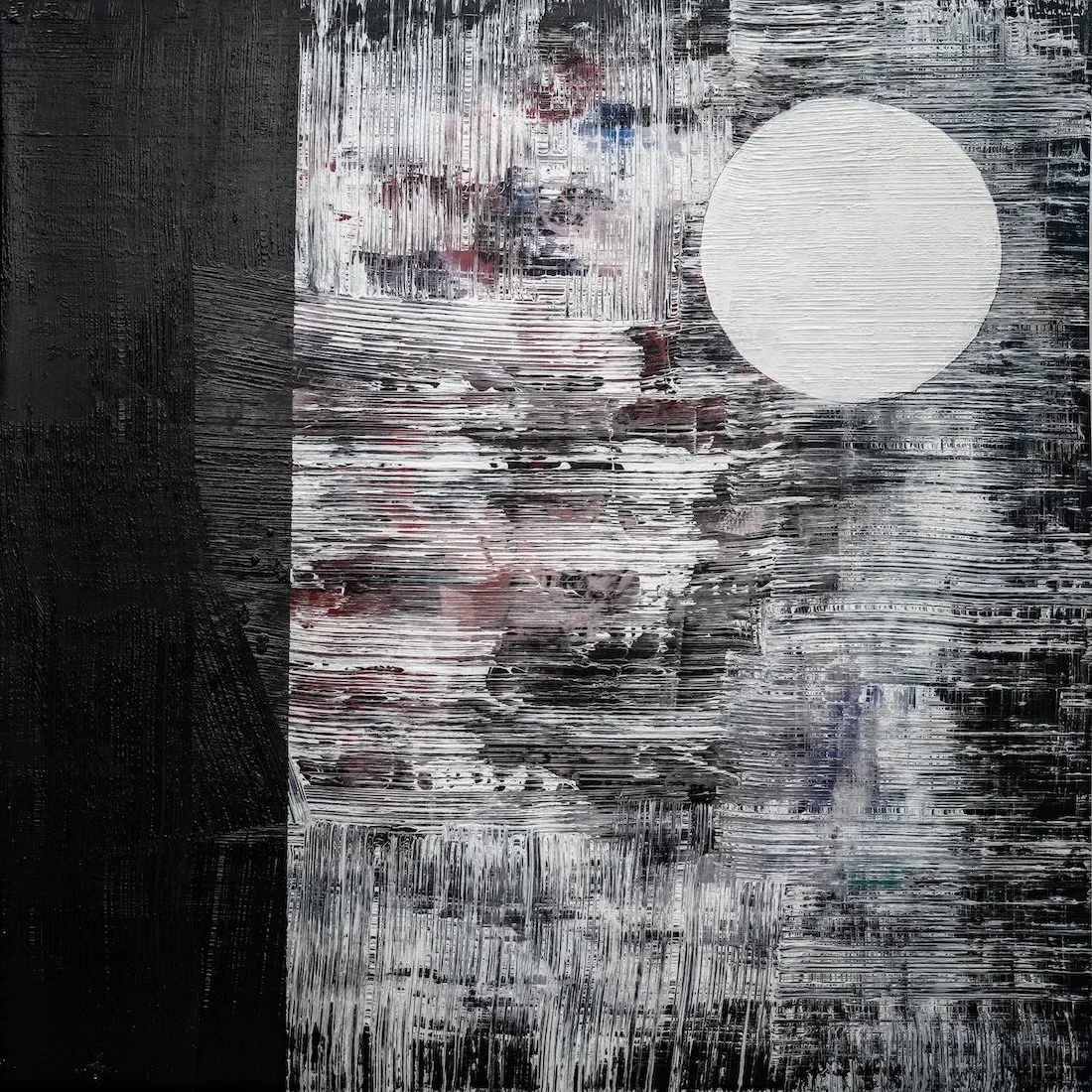
Moon Over Lake holds its subject with unusual candor: moon, water, reflection, the full architecture of a night landscape rendered legible, even inevitable. At seven feet square, the work does not frame the scene so much as become a kind of threshold, a surface large enough to make the familiar feel structural rather than decorative. Black and white are not stylistic choices here but conclusions, the painting insisting that this particular subject was always monochrome and that color would have been a kind of falsification.
The Abstraction Quotient is negative one. That proximity to the recognizable is where the real pressure lives. Read against a Texture of three and a Form of three, the work earns its legibility through density rather than clarity, surface and shape doing labor that representation alone could not sustain. A Color Range of one is not poverty but precision, and a Mood of two keeps the register close to somber, resisting any drift toward the picturesque.
What the painting risks is sentiment, the night lake being among the most conventionally charged subjects in the catalog. What it refuses is consolation of the easy kind. Its cost is the trust it places in an image almost everyone has already seen, betting that fidelity, scale, and the insistence of Inky Black against Soft White will make solitude feel earned rather than borrowed.
Solitude
held breath suspended time vast quiet witness
STANDING THERE
You are very small and the moon does not care and somehow that is exactly the comfort you needed.
WHAT LINGERS
The water has changed its whole nature just by being looked at, and you wonder if you have too.
WHO IT FINDS
A year could pass inside this silence and no one would know, not even you.
Where it lives
- LIGHT
- Any lighting — monochrome palette is lighting-agnostic
- MINIMUM CEILING
- 10 ft
- MINIMUM WALL
- 10 ft
- DAYLIGHT
- Monochrome palette works anywhere — most flexible collection