Made overUnderwater Light Play
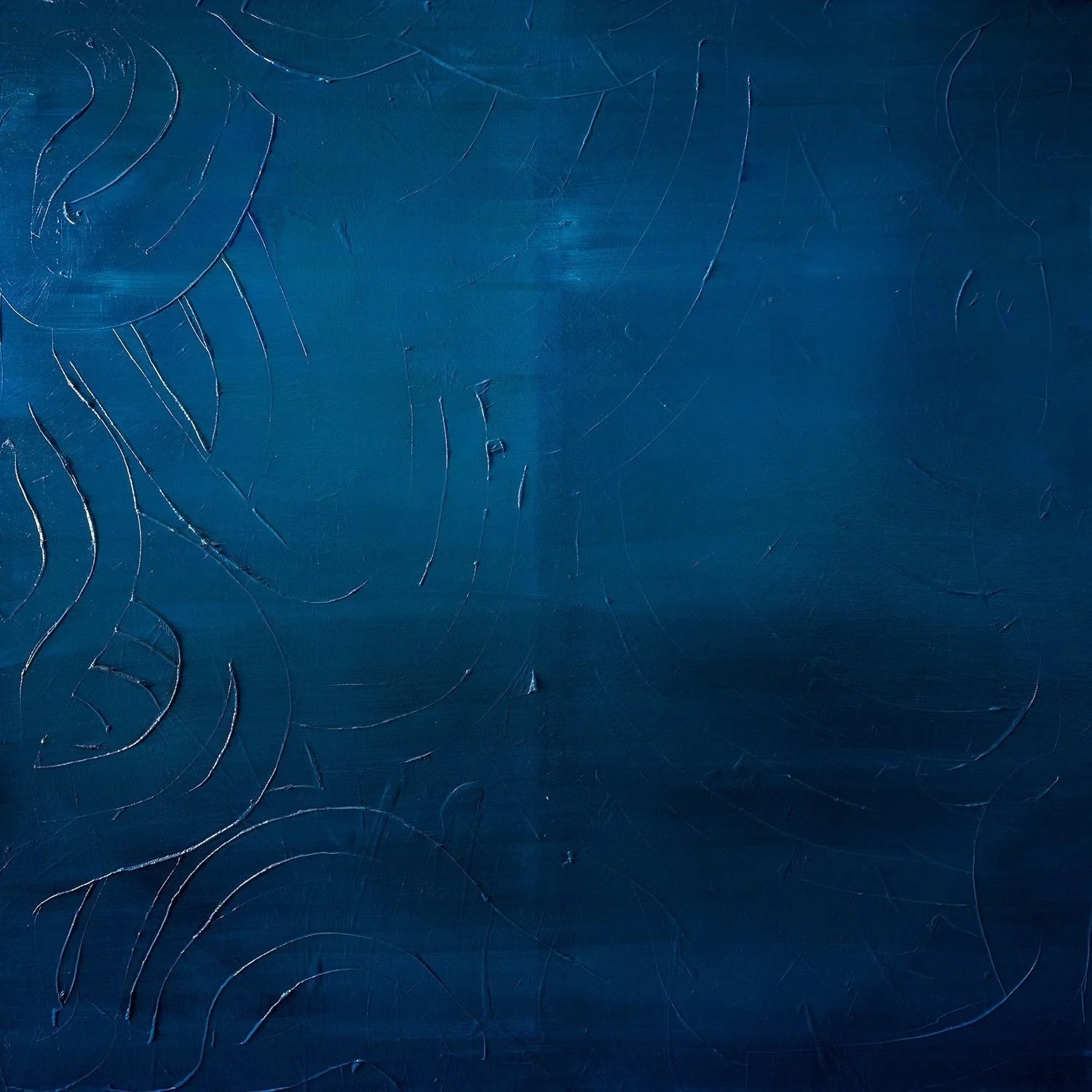
Neelkanth is one blue at five feet square, and almost everything in it is decided by what has been left out. There is no horizon, no second color family, no passage of light that could be called an event. What there is instead is a column of long incised arcs running down the left third of the canvas, cut into the paint rather than laid onto it, and a field that opens toward the center and closes again into near-indigo at the upper corners. A faint vertical shift in value sits at about two thirds across, and reads as a change in the light rather than a division of the space, which is the more interesting of the two options.
The numbers are unusual in combination. Color range is 2, four pigment states inside a single hue, enough separation to build depth and not enough to constitute a palette in the ordinary sense. Contrast is low, which means the drama is not in value at all but in relief: the arcs catch a silver highlight from the side and vanish from the front, so the painting is materially different depending on where the viewer stands. Texture is 3 rather than higher, because the ground is unusually smooth and the worked passages are confined to the incisions. Form is 4, which is the reading that took longest to settle — nothing here has an edge, but the gestures are complete and emphatic, and form in this catalog is a measure of formal presence rather than of boundedness.
Underneath is Underwater, a five-by-five oil from 2024 in the Pulse of Life collection, and the substrate is unusually apposite. Both are blue because of what is suspended in them; both are about looking through something rather than at it. The transformation kept the medium, the format and the hue family and changed only the metaphysics. The title supplies that change. Neelkanth is Shiva blue-throated, having drunk the poison at the churning of the ocean and held it rather than swallowed or spat it out, and the color is the consequence of the holding. The incised marks are the veins where what is held comes nearest the surface. This is not a picture of the throat. It is the view from inside the skin, and the reading is available to a viewer who has the myth and closed to one who does not — the painting is a field of blue either way.
The source condition was ordinary: the drive between Phoenix and Munds Park under cloud, when overcast strips the warm end from the light and the far ridges collapse into a single blue with density variations rather than receding in stages. What survives of that in the painting is not the mountains but the condition itself, which is the distinction the work is making.
Reverence
held deep quiet carrying unreleased
STANDING THERE
The breath goes shallow and slow at the same time. There is nothing to resolve, so the body stops trying to, and what is left is a kind of attention that does not feel like effort.
WHAT LINGERS
The silver on the arcs, and the sense that the blue is the result of something rather than a choice.
WHO IT FINDS
It finds the part of me that is carrying something and has decided not to put it down.
Where it lives
- LIGHT
- Raking light from one side is essential — it is the only condition in which the incised arcs read. Flat frontal light collapses the painting to a single blue plane. Cool or neutral bulbs keep the field true; warm light pushes it toward gray.
- MINIMUM CEILING
- 9 ft
- MINIMUM WALL
- 7 ft
- DAYLIGHT
- Cool-dominant and low in contrast, so it holds steady through Arizona daylight rather than shifting the way warm work does. Strong direct sun will, however, wash out the relief.