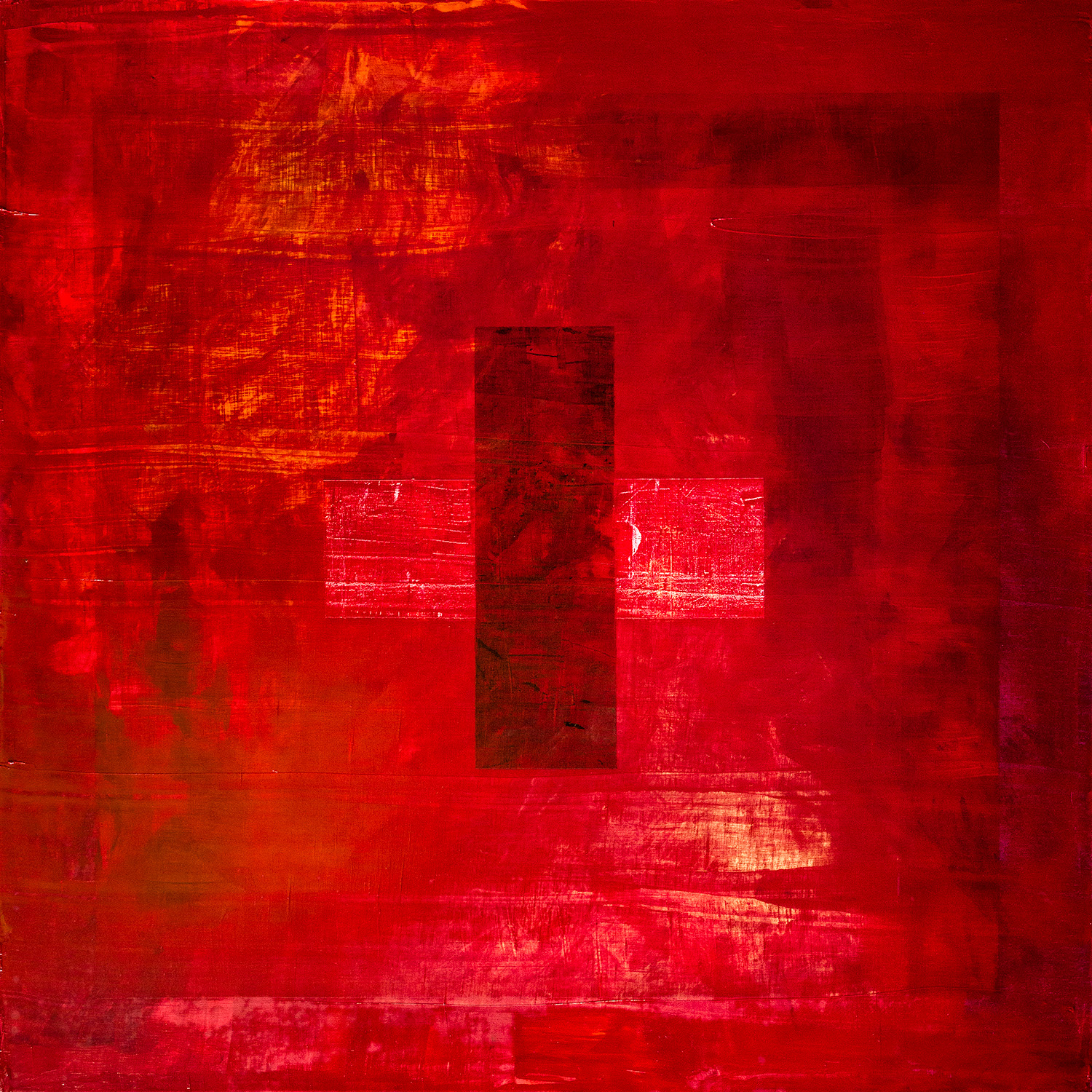
Odhni is a single hue carried across four feet, and the measurement is worth stating because it contradicts the first impression. The pigments span a luminance range of 32 and a hue spread of under three degrees — this is one red at six depths, not a red painting with variety in it. Contrast reads 2.6, below the catalogue median. Yet the painting appears high-contrast, because the dark upright and the two pale scraped bands are the only places where value changes abruptly, and the eye takes local sharpness for global range. The whole composition depends on that misreading being pleasurable rather than a cheat.
Form is 4, which makes this the most structural work in the recent group. A dark vertical block runs from just above centre to well below it; two lighter horizontal panels cross it left and right, their surfaces abraded so that pale scratches catch across them. Everything else is field. The structure was not drawn so much as left — it is where the covering red was not taken all the way down, which is exactly what a length of cloth does over an object. Texture at 3 sits at the median and is doing quieter work than in Jheel: the wiping and layering give the field its depth, but they are not the subject.
Two things should be said plainly rather than left for someone else to notice. First, a dark vertical crossed by pale horizontals, rendered in red at this scale, will be read as a cross by a substantial number of viewers, and by some as a medical one. That reading is not available to be withdrawn, and it sits at an angle to a title naming a North Indian veil. The painting can carry the tension — a garment and a cruciform are both things laid over a body — but the collision should be intentional in the copy rather than discovered by a collector. Second, this is oil over a cured acrylic ground, which is the sound direction and the opposite of the note recorded against Rajasthani Ghagra. Underneath is Red & More, a 2021 acrylic from Geometric Splendor whose blues and charcoal lines are now entirely buried; nothing of the source bruises through, which makes this the most fully covered of the transformations to date.
Reverence
witnessed without being seen held ancient thread quiet accounting
STANDING THERE
the chest goes still and the feet feel rooted to the floor as if the painting is taking attendance
WHAT LINGERS
the two scraped bands, and how much light they hold given that they are the same red as everything else.
WHO IT FINDS
the part of me that has always suspected my life is being quietly recorded by something I cannot name
Where it lives
- LIGHT
- Even light is enough for the colour, but raking light is what makes the weave and the scraped bands declare themselves — under flat illumination the surface flattens into a single red and loses the layering that is most of the painting. Warm light deepens it; cool light pushes the crimson toward pink.
- MINIMUM CEILING
- 8 ft
- MINIMUM WALL
- 5 ft
- DAYLIGHT
- Warm-dominant and heavily saturated, so Arizona afternoon light intensifies it considerably. A north or east wall holds it steadier than a west-facing one, where late sun will drive the whole field hotter than it was painted.