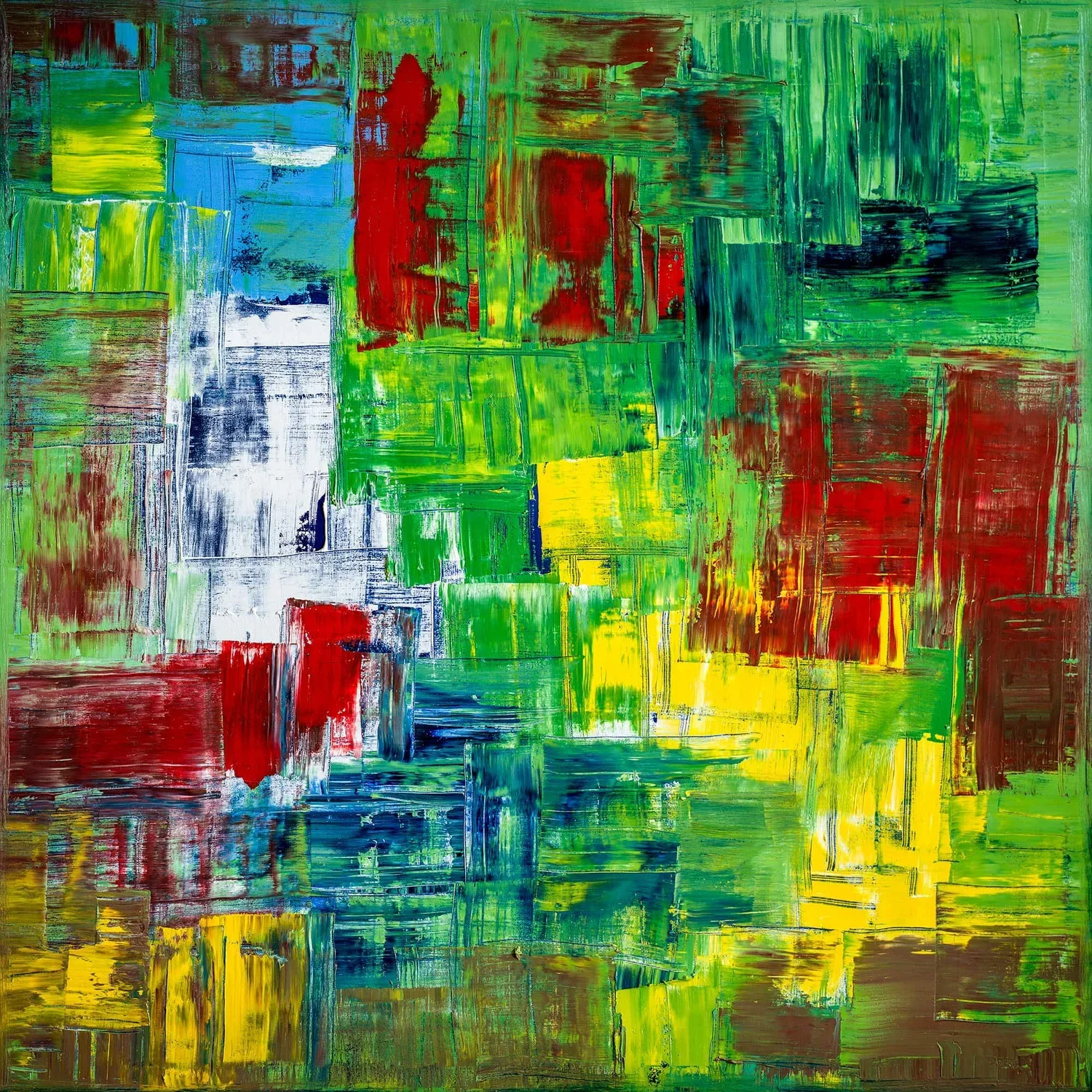
Primary Cacophony sits at the junction of maximum chromatic commitment and structural restraint, a painting that names its ambition directly and then earns it. The four pigments, forest green entering an otherwise orthodox primary triad, introduce a fifth note into what the title promises as collision. That decision is not decorative. Green is the only color here that was made, not chosen from nature's primaries, and its presence reframes the argument from doctrine to conversation.
The work refuses resolution before it refuses representation, and the Abstraction Quotient of 3.5 is precisely the instrument that explains why. At that position, forms have shed their names but not their pressure; the composition retains enough structure to produce a Color Range of 4 reading as tension rather than decoration, and a Mood score of 4 that cannot simply be called brightness because the forest green and cadmium red together keep softness and resistance alive at the same pitch simultaneously.
Against the catalog, this painting occupies a calculated middle risk. It does not pursue the extremity available to it, sitting below the abstraction ceiling and refusing the safety of cool palettes. The cost is exposure: primary color at this saturation and scale is easy to dismiss as earnest, even naive. Raj accepts that liability and answers it with compositional rigor. Whether the answer fully satisfies is the question the catalog keeps open.
Aliveness
collision without collapse breathing
STANDING THERE
The colors argue at full volume and yet nothing breaks, as if the painting has learned to hold its own chaos without flinching.
WHAT LINGERS
There is something almost bodily about it, the way red and blue and yellow press against each other the way people do in a crowded room where nobody leaves and nobody surrenders.
WHO IT FINDS
Underneath the noise, in the places where the primaries bleed into each other, something surprisingly soft is waiting, not peace exactly, but the tenderness that lives inside honest disagreement.
Where it lives
- LIGHT
- Natural light preferred — oil layers shift through the day
- MINIMUM CEILING
- 8 ft
- MINIMUM WALL
- 5 ft
- DAYLIGHT
- Natural light from nearby glass enhances layering — flexible