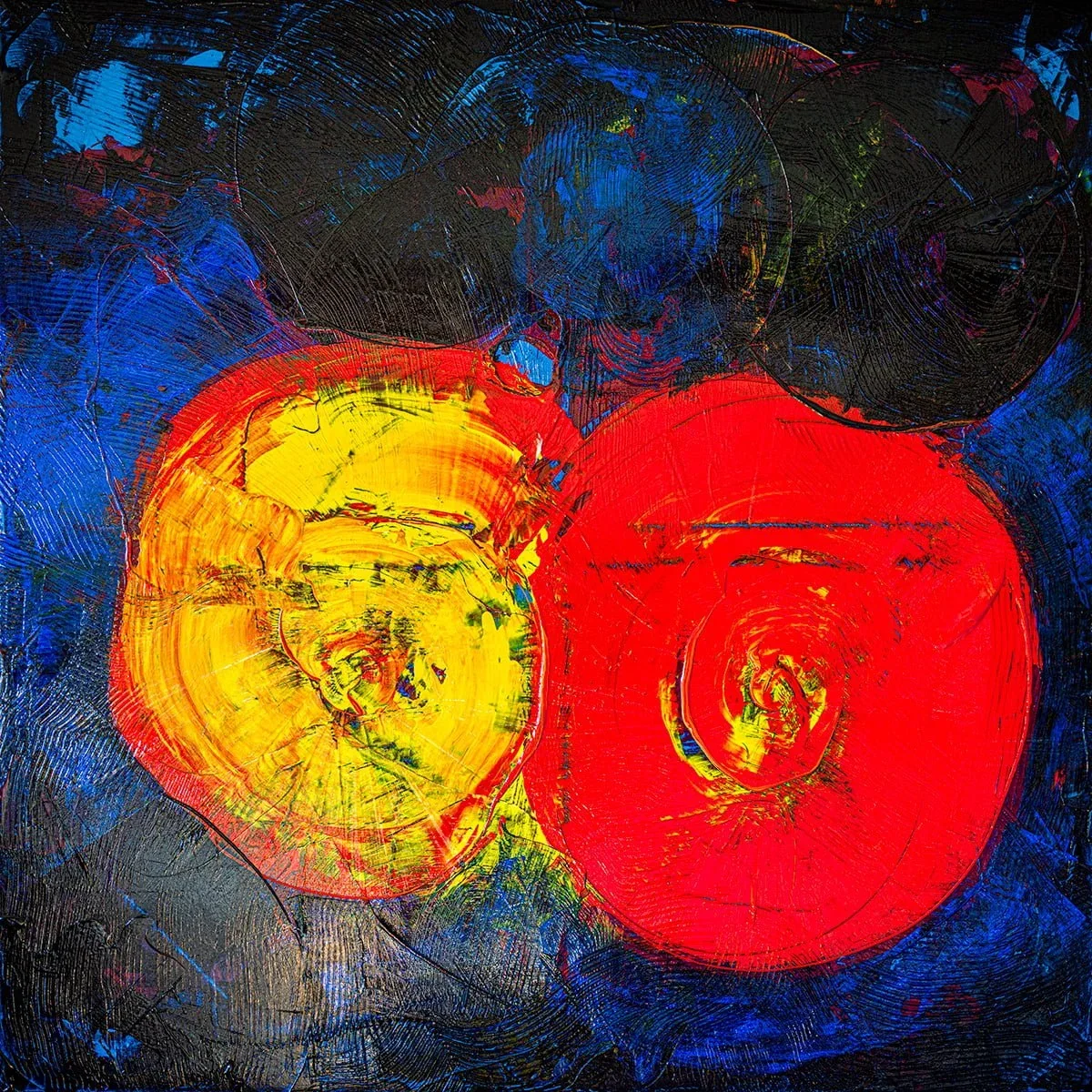
Proton Song engages materiality as philosophical inquiry, where the collision of acrylic and oil generates fractal ruptures that dissolve the figure-ground hierarchy, a kinetic abstraction that turns the canvas surface into an active participant. The restraint of the composition belies its ambition: four bodies, two languages of presence, one field of energy.
The Abstraction Quotient of 5 signals maximum formal abstraction, yet the thematic framework around embodied presence and bodies in dialogue complicates any purely formal reading. That is the productive tension at the work's core. The ground is not background. It is the painting's second voice: pulled in wide arcs, kinetic and atmospheric, alive with the energy the orbs have already passed through.
This is not a painting about physics. It is a painting about what physics is trying to say: that matter wants to move toward other matter, that contact creates light, that at the subatomic level, everything is already singing.
Awe
collision births unexpected order trembling
STANDING THERE
You stand before something that happened rather than something made, the paint having negotiated its own terms while the artist only offered conditions.
WHAT LINGERS
The eye cannot settle because every gap opens into another layer of time, each fractal edge a record of two materials refusing to agree yet somehow arriving somewhere true.
WHO IT FINDS
In the space between what was intended and what emerged, the work quietly insists that intelligence was never yours alone.
Where it lives
- LIGHT
- Natural light preferred — oil layers shift through the day
- MINIMUM CEILING
- 9 ft
- MINIMUM WALL
- 8 ft
- DAYLIGHT
- Natural light from nearby glass enhances layering — flexible