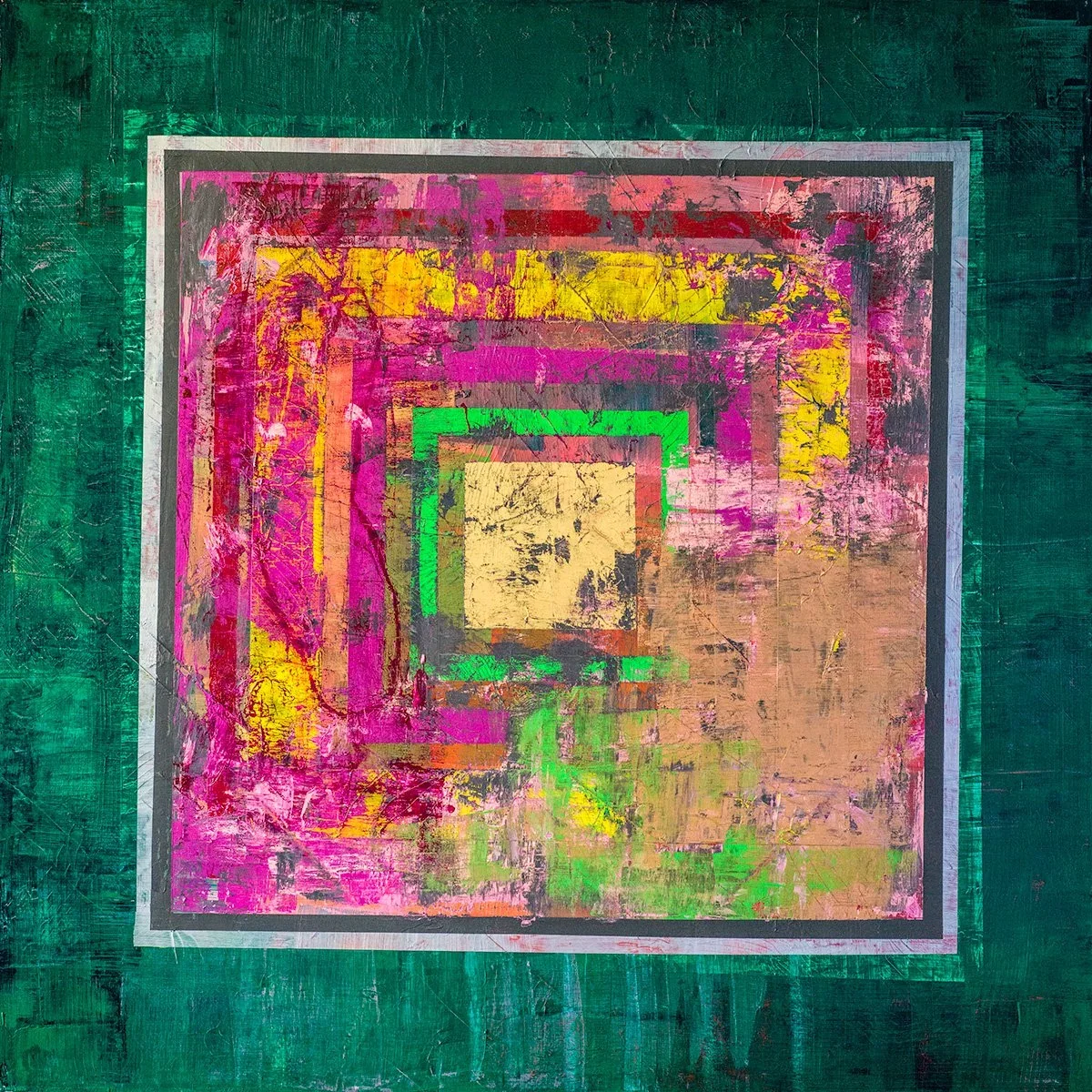
Rangoli in Permanence takes a form built to be destroyed and refuses the second half of the bargain. The pattern belongs at a doorway, laid in powder, walked across all day and gone by evening. Here it is nested squares in acrylic, held at the center of a five-foot canvas, with a green field pressing in from every side as though the floor had been lifted off the ground and hung on a wall.
At an Abstraction Quotient of 4 the pattern has left the doorstep and become structure. The color range sits at 5, a level only eight works in the catalog reach: malachite against neon green, magenta against warm gold, crimson beside near-black, none of it resolved into a scheme. Texture, at 2, is the surprising number. The surface stays almost flat, because powder on stone has no impasto, and the painting keeps that one fact after abandoning everything else about the original.
What it argues is that an inherited form can be carried without being preserved. The geometry is neither quoted nor modernized. It is simply used, at scale, in the wrong material, by someone with the standing to use it, a harder position to hold than either homage or rupture, and one the painting takes without explaining itself.
Reverence
ancient pattern holding time still
STANDING THERE
The chest opens quietly, as if something sacred is being witnessed that was never meant to be rushed past.
WHAT LINGERS
The feeling that someone poured devotion into geometry, and that devotion outlasted the moment it was made for.
WHO IT FINDS
It finds the part of me that knows some acts of love are not meant to be swept away.
Where it lives
- LIGHT
- Warm ambient light enhances terracotta and gold
- MINIMUM CEILING
- 9 ft
- MINIMUM WALL
- 7 ft
- DAYLIGHT
- Warm palette is complementary to Arizona morning light — sui