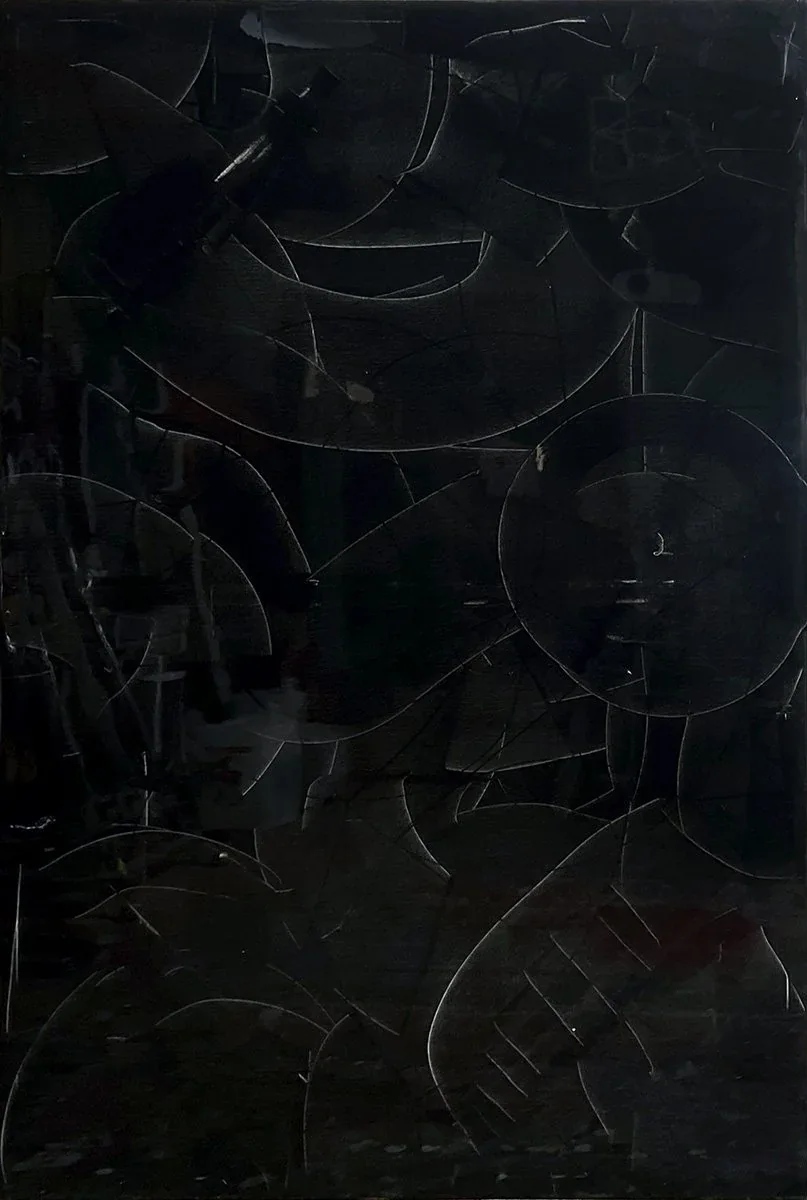
Scratched Black Mirror is a near-total suppression of form that holds its suppression as subject matter. At six by four feet, the canvas operates at the scale of confrontation: it is too large to treat as object and too unified to read as scene. The matte black ground, pulled toward surface by epoxy resin, refuses the eye's instinct to look through it and instead keeps attention on the plane itself, where the silver scratching runs like a system of faults across a field that was never stable.
Mood registers at 1, the most extreme value in this work, and that near-total somber commitment reframes what the Abstraction Quotient of 4.5 actually accomplishes. The painting is almost beyond the recognizable, but not quite: the scratches preserve just enough directionality to read as gesture, and together with the constrained color range of 1, the almost-nothing palette transforms restlessness into something more precise than chaos.
What the painting risks is the elegance of pure negation. It sits in the catalog as one of the more self-enclosed works, resistant to sequence, refusing the warmth of neighboring canvases. That refusal is its argument and also its cost: a painting that insists on its damage as content must earn every inch of the surface, and here, largely, it does.
Restlessness
fractured glass fractured self searching
STANDING THERE
You stand before something that has been broken in the act of trying to see itself clearly, and the breaking feels familiar.
WHAT LINGERS
The scratches hold the ghost of a hand that needed to leave proof it was here.
WHO IT FINDS
In the darkness behind the damage, something is still watching back.
Where it lives
- LIGHT
- Low ambient light amplifies luminous passages — dark-wall installation ideal
- MINIMUM CEILING
- 9 ft
- MINIMUM WALL
- 8 ft
- DAYLIGHT
- Best on solid interior wall away from competing natural ligh