Made overIndustrial Whispers: Pipe
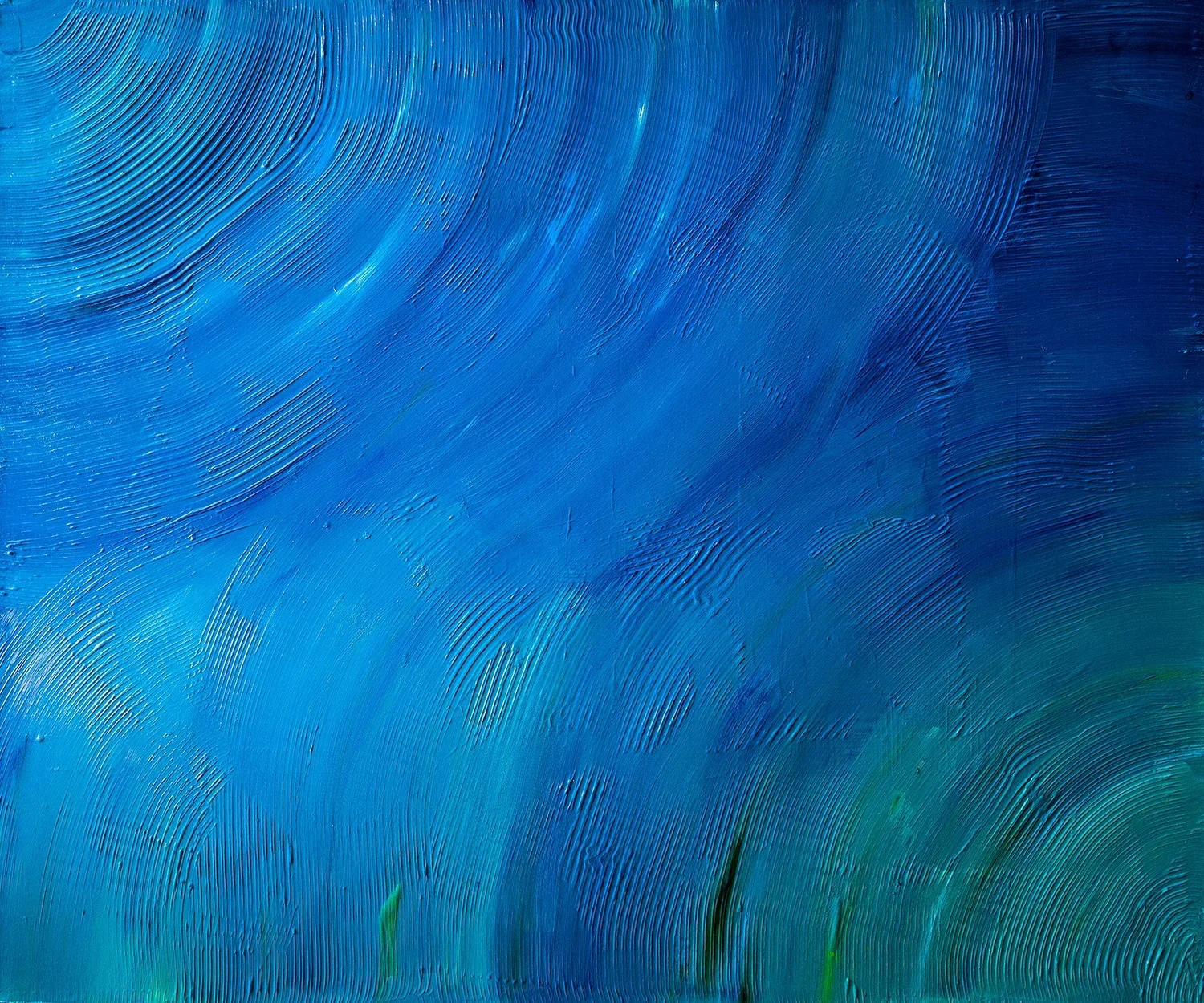
Sea Change is a weather system with no horizon to organize it. A long sweep enters from the upper left and carries down and across, combed into ridges so fine and so continuous that the whole surface behaves like water read from above rather than water seen from a shore. The upper right sinks into near-navy. At the lower edge and lower right, green arrives, viridian and a warmer sea green pushing up through the blue, reading unmistakably as something surfacing rather than something applied.
Texture is 5, the highest in the catalog's range, and it carries the painting almost alone. Color range is 3: three families, blue to teal to green, with no warm note anywhere to relieve them. That narrowness is what makes the green at the bottom register as an event instead of a passage. Abstraction quotient is 5. There is no sky, no waterline, no vessel; what makes it legible as water is entirely the behaviour of the ridges, which is a claim about how little a painting needs in order to be understood.
Underneath is Industrial Whispers: Pipe, a six-by-five acrylic from 2024 in the Black and White collection, a painting that argued, after Magritte, about the distance between what we see and what we know. It is now a painting that cannot be seen and is known only from its record. The title comes from The Tempest, where a body under water is not destroyed but altered into something rich and strange, and the phrase has since been worn smooth by boardroom use. The painting takes it back to the literal case. Something is down there. It did not survive intact and it did not disappear.
Solitude
deep moving cool submerged patient
STANDING THERE
The breath drops lower in the chest. It feels like being underwater in the good way — held rather than trapped, with the surface somewhere overhead and no urgency about reaching it.
WHAT LINGERS
The green at the bottom edge, and the sense that it came from somewhere below rather than from the artist's hand.
WHO IT FINDS
It finds the part of me that is comfortable alone, and does not mistake that for loneliness.
Where it lives
- LIGHT
- Cool or neutral light keeps the blues true; warm bulbs push the field toward gray. Side light brings the combing forward.
- MINIMUM CEILING
- 9 ft
- MINIMUM WALL
- 8 ft
- DAYLIGHT
- Holds up well in strong daylight — the cool palette does not shift the way warm work does under Arizona sun