Made overVisual Echoes Of Vermont
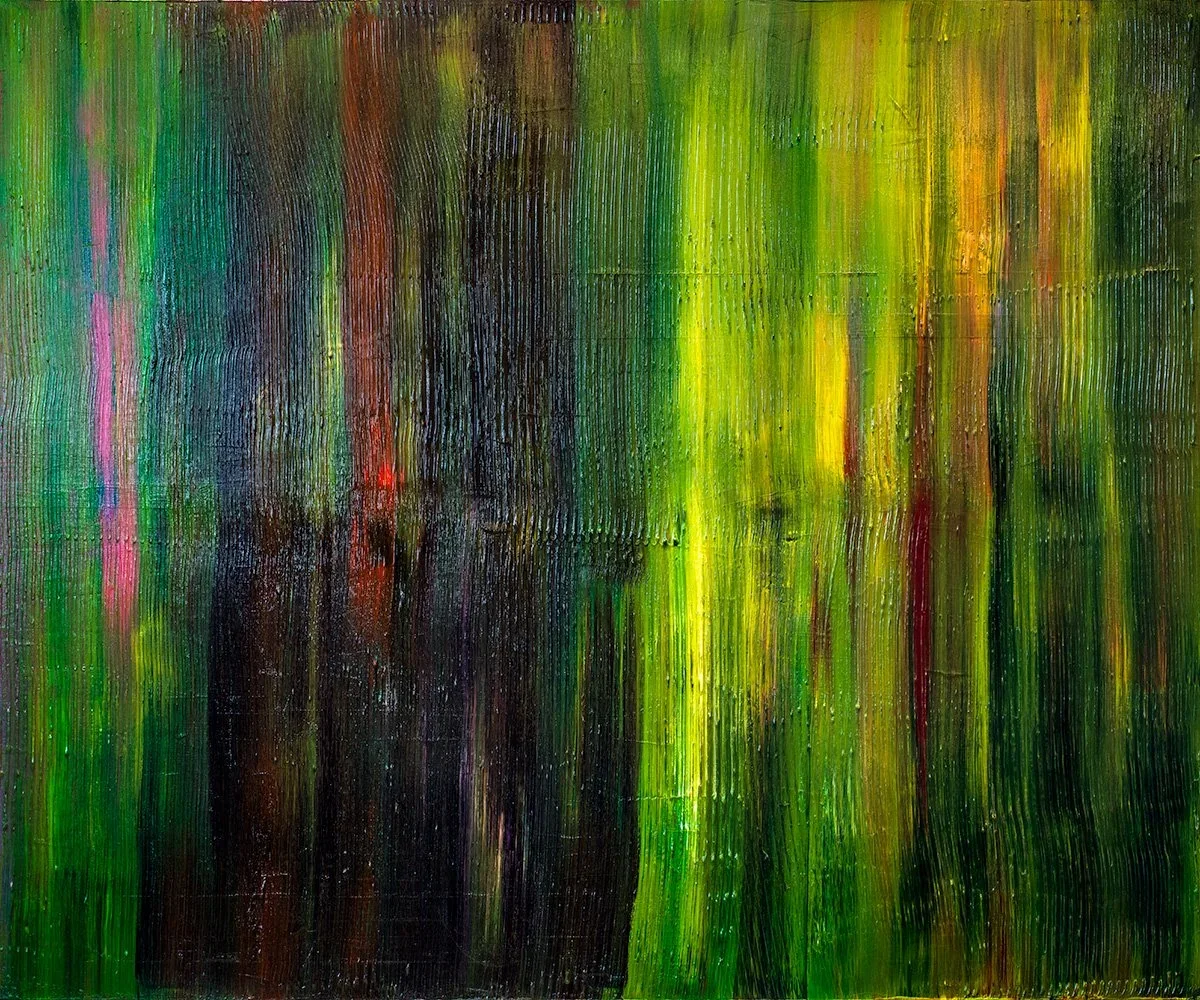
Sunken Forest gives the eye nowhere to arrive. The green runs the full height of the canvas, combed from crown to root, and the combing is not decoration but the whole method: a single vertical grain that refuses to gather into incident anywhere on the surface. Light comes through it the way light comes through a canopy, filtered, with no source you could point to. What the work offers is not a view but a position inside one.
At an Abstraction Quotient of 2, Sunken Forest retains just enough of the world to name itself without resolving into scene. The Viridian and Moss of a high Texture rating pull in opposing directions: the surface is dense, worked, physically insistent, yet Form sits at 1, offering almost nothing to hold. What survives of recognition is atmospheric rather than structural, a vertical pressure of green that implies canopy without depicting it, while a Mood of 3 neither mourns nor celebrates the solitude the record assigns it.
Sunken Forest is a field painting working at the edge of that tradition's demands. Against the broader catalog it occupies a narrow threshold: figurative enough for the title to land, abstract enough for the title to matter. The red thread and the magenta seam are the work's real gamble, two warm intrusions into a cold chromatic world, risking prettiness and narrowly refusing it. What the painting costs is a center, and it pays that price deliberately, staking its coherence on the whole surface rather than any part of it.
Solitude
no center to find falling vertically light arriving filtered being inside rather than in front
STANDING THERE
I stand in it rather than before it. My eyes stop searching for the place they are supposed to go, and something in my shoulders lets down when they do.
WHAT LINGERS
The one red thread lingers, and the magenta at the far edge. They are the only warm things in a green world, and they are what keep it from being a landscape.
WHO IT FINDS
This finds the part of me that is content to be alone in something large, the part that does not need a center to know where it is.
Where it lives
- LIGHT
- Warm to neutral light, angled across the surface. The vertical comb is what carries the color shifts, and flat frontal lighting will flatten the whole field into a single green.
- MINIMUM CEILING
- 9 ft
- MINIMUM WALL
- 8 ft
- DAYLIGHT
- Handles daylight well. The dark ground absorbs glare and the greens deepen rather than wash in natural light.