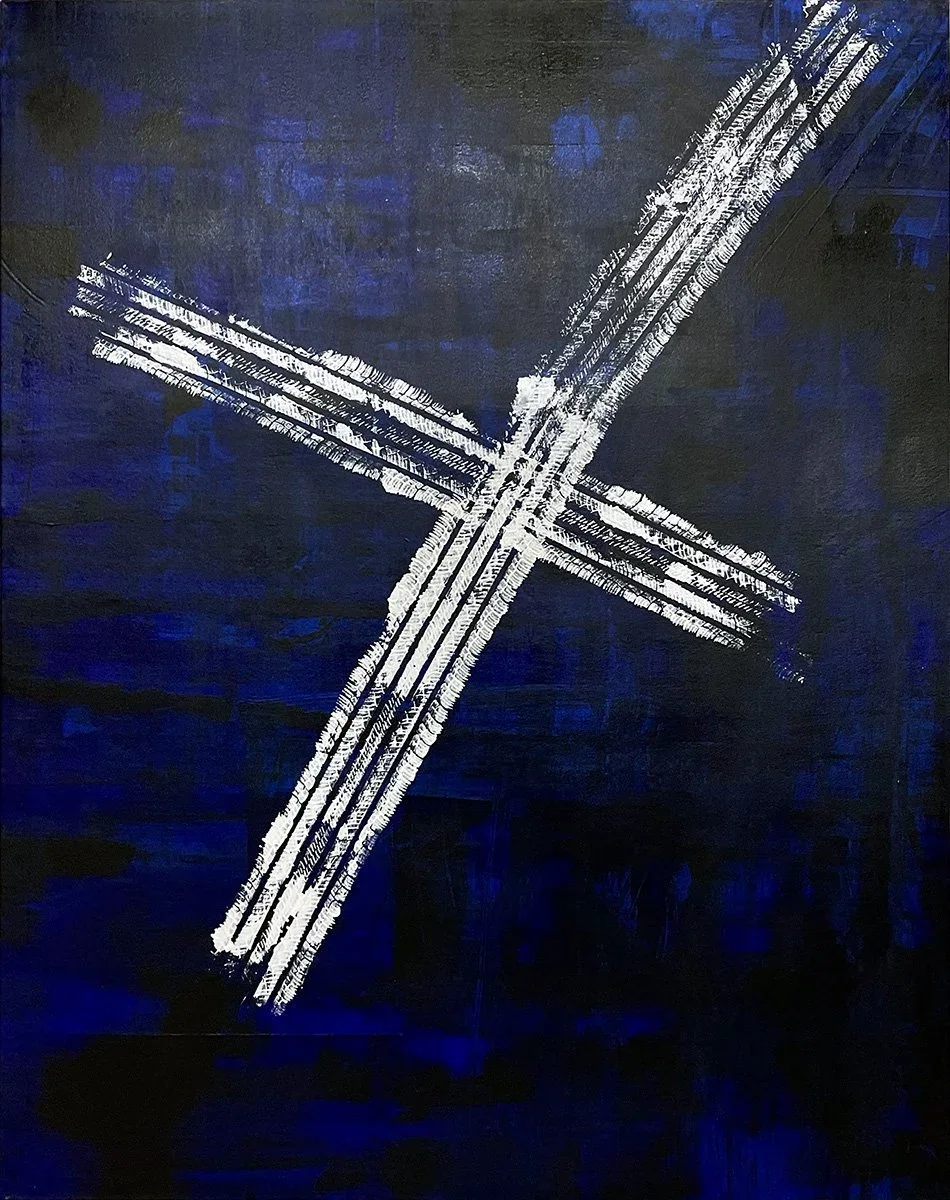
Vanishing Tracks holds its large scale as a kind of pressure, eight feet wide and six feet tall, not to overwhelm but to insist that whatever is receding does so at full size. The composition works in the grammar of aftermath: not absence yet, but the moment just before absence completes itself. Slate and umber carry the weight of what was, while pale turquoise opens a corridor that the eye follows until it cannot.
The Abstraction Quotient is 2.5. That middle position is where this painting earns its particular tension: form remains high enough at 4 to suggest structure, a path, a mark, something that moved here, while color range and mood both sit at 2, restrained, keeping the palette from consoling what the composition refuses to resolve. The numbers pull against each other, and the work lives in that friction.
Against the broader catalog, Vanishing Tracks risks sentimentality without quite surrendering to it, the title doing work the paint cannot always finish alone. What it refuses is resolution, and that refusal is serious. Its cost is legibility: the hooks hold, but just. Works in Abstract Inquiry that sit closer to 4 or 5 on the Abstraction Quotient make no such concession to the nameable, and this painting must justify its middle position on its own terms, which it very nearly does.
Longing
fading imprints dissolving memory quiet erasure
STANDING THERE
Something once vivid and present is now only barely traceable, like breath on glass already clearing.
WHAT LINGERS
The ache of things that mattered deeply but left only the faintest evidence they were ever there at all.
WHO IT FINDS
Even in the vanishing, the painting insists that the trace itself is enough — proof of having moved through.
Where it lives
- LIGHT
- Natural light preferred — oil layers shift through the day
- MINIMUM CEILING
- 10 ft
- MINIMUM WALL
- 10 ft
- DAYLIGHT
- Natural light from nearby glass enhances layering — flexible