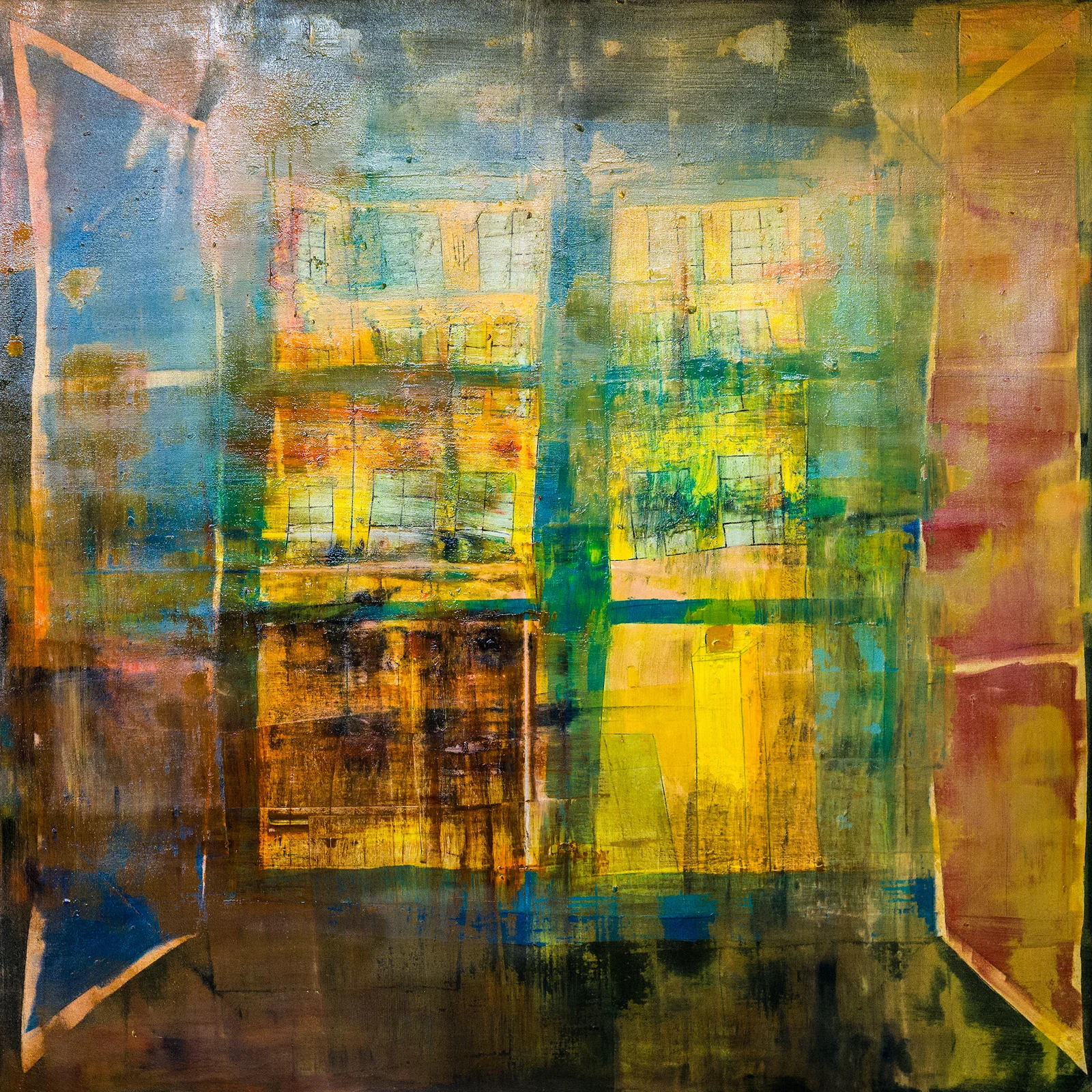
Standing before it, you look out through it before you look at it. Two shutters swing open at the edges, one blue and one rose, and between them a building rises in yellow and ochre, its windows drawn into the wet paint with a fine point, crooked, counted by hand. Below, the street does not arrive. It thins into drips of rust and gold and dark green, as if the scene gave way the moment the eye reached for the ground.
Window to Seeing holds an Abstraction Quotient of 1. You can still name what is here: shutters, a facade, a row of windows. But the language is already straining. The perspective is impossible, the light comes from inside the walls rather than from the sky, and the lower half has been released from description altogether. It sits just past the border of the abstract, where a painting has stopped reporting a place and started remembering one.
The window is one Ritu Raj saw in Picasso's home in Paris, and the canvas waited four years, from 2022 to 2026, before he went back and finished it. That delay is in the painting. Nothing here is observed; everything is recalled, and recall is its own kind of abstraction, keeping the frame and losing the facts. The low reading on the scale is not a lack of ambition. It is the point: a painting about the act of seeing has to keep one hand on the thing seen.
Longing
remembered opened gilded scratched held
STANDING THERE
I stand where the shutters open, and I keep waiting for the view to settle into a place. It never does. It stays a memory of a place, which is closer.
WHAT LINGERS
The small windows scratched into the yellow, crooked and hand drawn, like someone counting the rooms of a house they will not see again.
WHO IT FINDS
This finds the part of me that remembers a window better than anything I saw through it.
Where it lives
- LIGHT
- Warm, even light from the front or slightly above. The yellow facade glows under warm light; raking light brings up the scraped and incised windows.
- MINIMUM CEILING
- 9 ft
- MINIMUM WALL
- 7 ft
- DAYLIGHT
- Hang it facing a real window if you can. Daylight warms the ochres and the blue shutter cools by contrast, so the painting shifts through the day like the view it remembers.