My father used to say that every great painting begins where language ends. I didn’t paint for decades after I left his house. When I finally did, those words were waiting for me, as if they had never left.
Reads onTaxonomy · When Words Run Out
A house where silence was never empty
I grew up in a house in Delhi where silence carried the clack of sentences taking shape. Books were stacked on every surface. Paintings leaned against the walls, waiting to be hung. The living room smelled of ink, paper and turpentine: the twin perfumes of my parents’ worlds.
My father, K.B. Goel, wrote about art with the intensity of someone translating thought into light. He belonged to the generation of post-Independence critics who believed India’s modernism could be both rooted and radical. The painters came often. Husain with his sweeping gestures. Souza’s sharp laughter. Raza’s meditative calm. Swaminathan’s quiet mysticism. They talked for hours, not about money or reputation, but about form and spirit.
I listened from the edge of the room, too young to follow and old enough to feel it. Those evenings became the underpainting of my life.
One taught me to see, one taught me to listen
My mother was a professor of English literature. She lived by the rhythm of language. Her voice had precision, every word chosen as if measured against light. She loved Eliot and Yeats, Tagore and R.K. Narayan. From her I learned that words can hold silence as well as sound.
If my father taught me how to see, she taught me how to listen.
Our dinner table ran on questions. What is beauty? What is truth in art? Can form exist without meaning? I didn’t have answers. But I grew to love the space those questions made.
“Look not at what he painted, but how he thought”
Once, standing in front of one of Souza’s angular figures, its face fractured and luminous, my father leaned down and whispered: look not at what he painted, but how he thought.
That sentence has stayed with me my whole life. It was my first lesson in abstraction: form is not appearance. It is perception made visible.
He also told me something I think about every time someone asks me what a painting means: criticism is not judgment. It is love disciplined by clarity.
Criticism is not judgment. It is love disciplined by clarity.
Two vocabularies
My parents gave me two vocabularies, one of analysis and one of imagination. My father’s world was disciplined and theoretical. My mother’s was emotional and interpretive. One sought structure, the other feeling.
It took me decades to see that I am the bridge between them, and that my paintings live in the space where their two worlds meet. From my father I inherited form: the rigor of composition, the ethics of inquiry. From my mother I inherited breath: the lyricism of intuition, and the courage not to know.
Together, they gave me abstraction.
What we inherit
When my father passed, his books came to me. Hundreds of them: art journals, exhibition catalogs, philosophy, poetry. I placed them in my studio, not as an archive but as a presence.
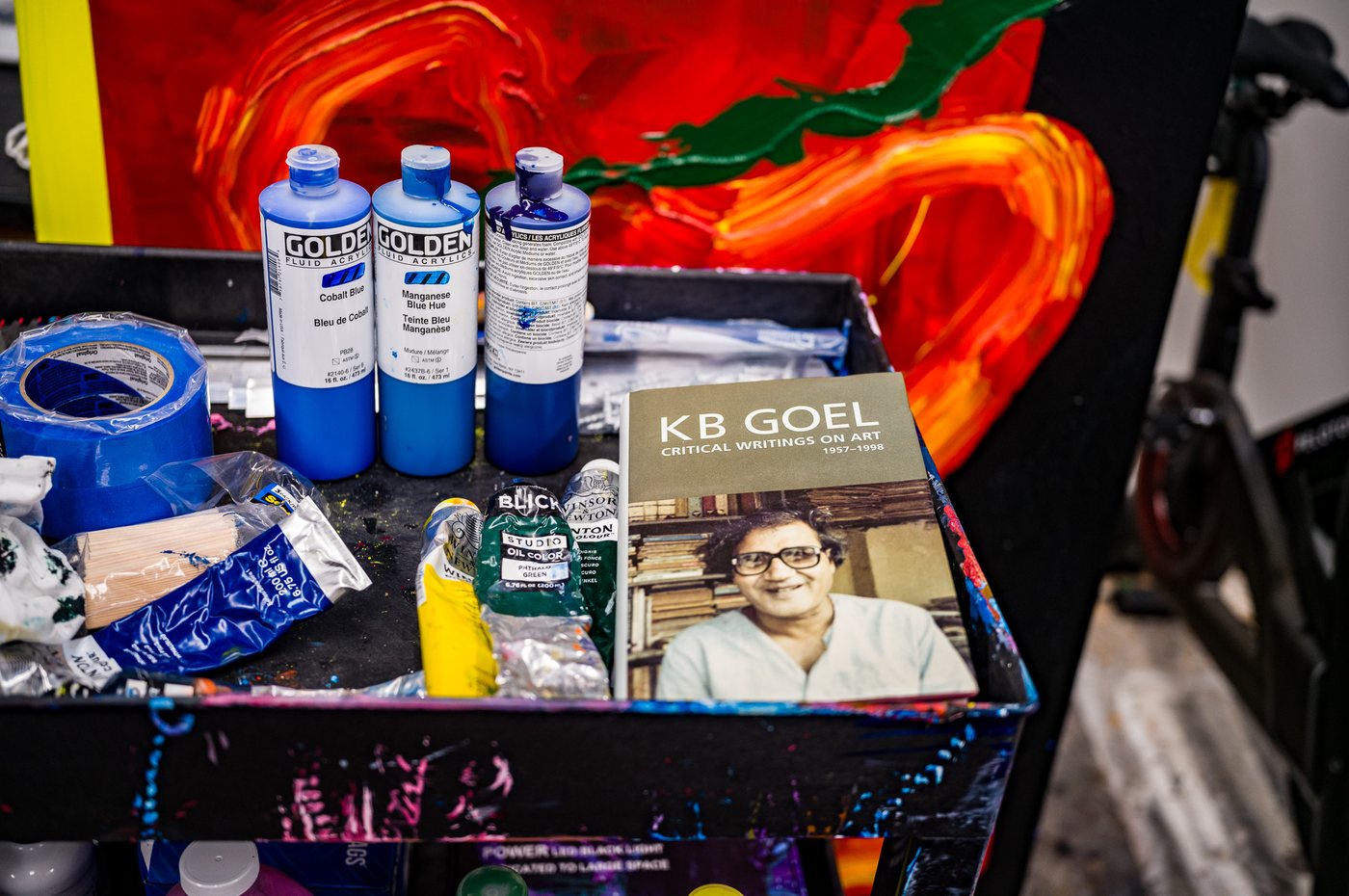
Some mornings, before I begin a painting, I pull out one of my father’s essays. His handwriting in the margins, small and exact, reminds me that thought can also be a form of art. Other days I read a poem my mother loved and find myself tracing its rhythm with my hand.
They did not teach me what to see. They taught me how to see: with care, with patience, with curiosity. That, I believe, is the true inheritance of vision. Not taste. Attention.
I sometimes imagine them walking into my studio. My father would circle a painting in silence before saying, “Yes, this is serious work.” My mother would smile and say, “It’s beautiful because it’s alive.”
Between those two sentences
lies everything
I have ever tried to do.
Ritu Raj is a painter, author and entrepreneur based in Phoenix, Arizona. His signature technique, Organic Movement, replaces the brush with thread. This essay is adapted from chapters 1 and 14 of his book The Shape of Seeing: The Genesis of Abstraction (American Real Publishing, 2026), available in hardcover, paperback and on Amazon.