A relationship cannot be specified in advance, so it cannot be automated. What can be automated is the transaction around it. The danger is not that machines will take our relationships. It is that we will quietly turn our relationships into transactions so the machines can run them, and then forget there was ever a difference.
Reads on fromRecognition and Disclosure
The cabin
I am writing this from the cabin, a few days away from the studio. The first morning here my hand kept reaching for the phone before I had decided to reach for anything. Not to call someone. Just to check. The reaching came first; the reason, if there was one, came after.
By the second day the reaching slowed. Something else came back in its place: the sound of my own attention. I noticed the light on the trees because no one had chosen it for me. I thought about a friend I had not spoken to in months, not because a notification reminded me, but because I missed him.
That small return is what this paper is about. In Recognition and Disclosure I argued that an algorithm gives us more of the world we already have, and abstraction gives us a world we did not know was there. Here I want to carry that argument out of the studio and into the place it matters most: the space between people.
The efficient world
In 2024 I painted a diptych called Politics. It is twelve feet wide, black and white. The left panel is concentric circles: precise, meditative, restrained. They return to themselves again and again. The right panel breaks open. Sweeping lines cut across the canvas, one panel trying to contain and the other refusing to be held.
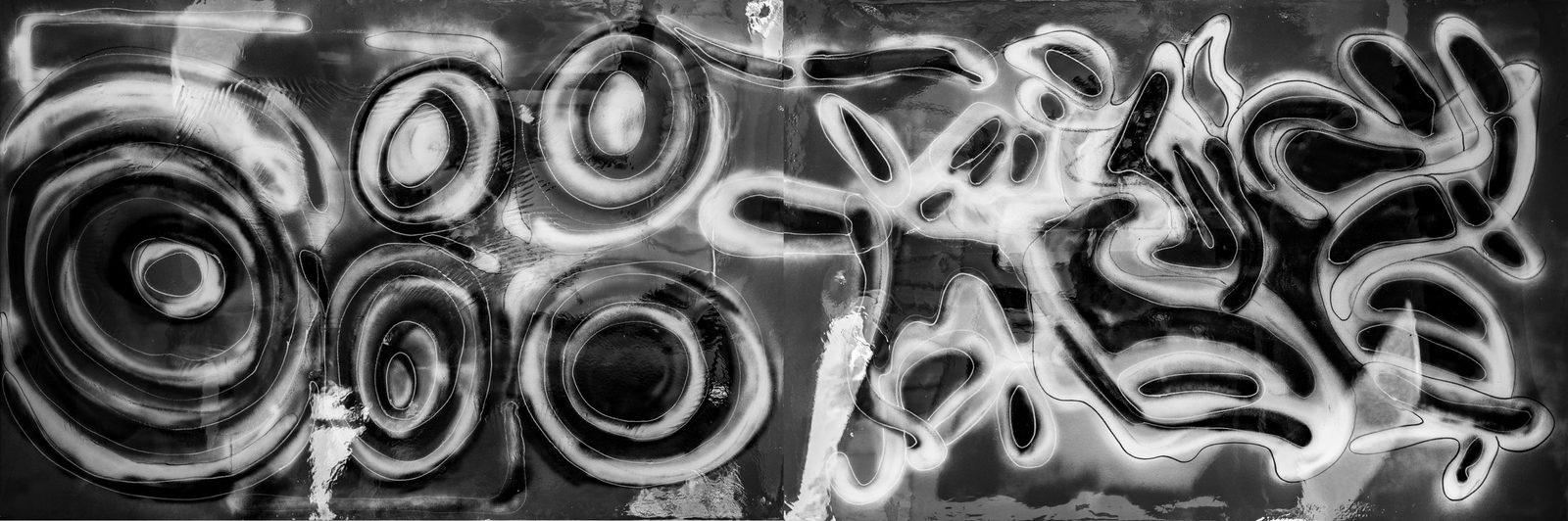
I did not know it then, but I was painting the loop and the relationship side by side.
The philosopher Jürgen Habermas gave us a map of this forty years before the feed existed. He saw society as two worlds. The system runs on money and administrative power; it coordinates people without their needing to understand each other, and it is efficient by design. The lifeworld is where meaning lives: family, friendship, conversation, culture. It runs on people reaching each other through language. His warning was what he called the colonization of the lifeworld: the system's logic creeping into places that only work through understanding.
An algorithm is the system's logic made portable. It now lives in every pocket. The feed decides whom we see. The app decides whom we date. The score decides who gets the job. Each step is efficient. Each step is a circle in the left panel, turning, returning, never quite arriving.
The loop is the system. The relationship is the lifeworld it is colonizing.
What the loop takes
When a system decides, judgment leaves the room. Blame does not.
The researcher Madeleine Clare Elish studied what happens when automated systems fail, from cockpits to the 2018 self-driving crash in Tempe, not far from my studio. She found a pattern she called the moral crumple zone. The human nominally “in the loop” has little real control over the machine, yet absorbs the moral and legal blame when it goes wrong, the way a car's crumple zone absorbs the force of a collision.
That is the strange bargain we are making. The loop takes the choosing and leaves us the consequences. Accountability without agency.
In The Unalgorithmic Self I wrote that when algorithms make choices for us, we forget how to choose. This is not dramatic. No one takes the choice away. We hand it over a little at a time, because it is easier, and the muscle weakens from disuse.
Hannah Arendt understood where this ends. Her warning was never mainly about people who intend harm. It was about people who stop thinking: who follow the procedure, fill in the form, do what the system asks. A loop is a procedure that never asks to be questioned.
So the first step back to the self is not grand. It is noticing the reach of the hand before the decision. And taking the choosing back.
A person cannot be specified
A century ago Martin Buber described two ways of standing toward the world. In the first, which he called I–It, we meet the other as an object: described, measured, used. We cannot live without it; it is how we cross the street and pay the bills. In the second, I–Thou, we meet the other as a whole presence, with no purpose laid over them. It cannot be planned or kept. It happens, and then it slips back into It.
Reading Buber again, I see the two halves of my last paper. I–It is recognition. I–Thou is disclosure. Recognition matches what is in front of us to what we already know. Disclosure lets something show itself that no category held in advance.
An algorithm can only ever work in I–It, because it can only act on what has been described. That is not a flaw to be engineered away. It is what an algorithm is. The data about a person is real. It is also exactly the part of them that is not the relationship.
Emmanuel Levinas went further. The face of the other, he said, summons us. It makes a claim we did not choose and cannot pass on. In The Unalgorithmic Self I put it this way: a system can simulate ethical language; it can't be ethically summoned.
You can model a person. You cannot meet a model.
Accountability that cannot be delegated
Some decisions are information problems. Others are relationship problems. Only the first kind can be handed to a machine.
Say a piece of work has to go either to group A or to group B. The data can rank them on cost, speed, past results. It cannot choose between them. The choice depends on who these people are to you, what you owe them, what you have promised, and what you are willing to answer for if you are wrong. In the end it comes down to instinct and abstraction: a reading of something that was never fully written down.
Hans Jonas, writing about technology in the 1970s, said responsibility grows with power, and it belongs to someone who can be asked why. A model can return a reason. It cannot be answerable. It will not lie awake. It will not apologize to the group it passed over, or sit across the table from them next year.
| Information decision | Relationship decision | |
|---|---|---|
| The question | What is true? | What do I owe? |
| Can it be specified in advance? | Yes | No |
| Who answers for it | The process | A person |
| Hand it to a loop? | Often, yes | Never fully |
Most of the harm I see comes from mistaking the second kind for the first. A layoff run as an optimization. A diagnosis delivered by a dashboard. A breakup sent by text. Each is efficient. Each leaves someone on the other end with no one to face.
To hold ourselves accountable is to keep the second kind of decision in human hands, even when the first kind gets faster. To hold others accountable is to keep asking, gently and without letting go: who decided this?
New paradigms
The way out is not refusing tools. I build tools. I paint with thread and gravity, and I have built a notation for paintings. The question is never tool or no tool. It is which tools leave the choosing with us.
Ivan Illich, in Tools for Conviviality (1973), drew that line. A convivial tool widens what a person can do on their own terms. Past a certain threshold, other tools begin to make people serve them. A pencil is convivial. A feed that decides what you see next is not. So the test for any system is plain: does it give my judgment back to me, or take it?
The economist Charles Goodhart left us a second test. In the form the anthropologist Marilyn Strathern later gave it, Goodhart's law says: when a measure becomes a target, it ceases to be a good measure. Optimize a relationship for a number, whether response time, engagement, or a match score, and the number survives while the relationship hollows out.
If efficiency is the virtue of the system, attention is the virtue of the lifeworld. A new paradigm would protect the slow, unscored parts of life: the conversation no one records, the decision made face to face, the hour in front of a painting. Not as nostalgia. As design.
What it asks of each of us is practice, not policy:
- Name which choices are yours, and keep them.
- Answer for what you decide, in person.
- Leave room for the person you cannot yet read.
- Spend some part of each day with something no algorithm chose for you.
The return to self, through others
A relationship is abstract in exactly the way a painting is. It has no subject you can point to. It lives only in what happens between.
A portrait can be checked against its sitter. A transaction can be checked against its terms. Both can be verified, so both can be automated. An abstract canvas has no original to match. Neither does a friendship, a marriage, the first real conversation with a stranger. Their meaning is made in the meeting, and it is new each time.
In ArtGraph, the Abstraction Quotient measures how far a painting has travelled from language, from the recognizable. It runs from zero, the border with representation, to five, where nothing is left to name it by. Low on the scale, the work turns algorithmic: repeated pattern, the known returning. A contract would sit off the scale entirely, everything named. A real encounter with another person sits at five. Little is named, and the not-knowing is where it lives. Politics reads 5.
People differ in how much of that they can bear. Some can sit with a canvas that offers no handhold at all; others want a trace of the familiar. I call this abstraction tolerance: the capacity to stay with what cannot yet be read, without reaching for a category to close it down. It turns out to be a social capacity too. It is what lets us stay with a person we do not yet understand.
We have been training ourselves to need everything named. Abstract art, and the people we love, ask us to unlearn that.
There is another diptych of mine, Unraveling. A thin white line wanders across two dark panels, loops, loses itself, and arrives at a single red circle. I have always thought of that circle as a point of return. That is what I mean by the self. Not a fortress we retreat to, away from others. The place we come back to, so that we have something real to bring to them.
We do not return to ourselves alone. We return through the encounters that no one could have scheduled for us: the friend we call because we miss him, the painting that holds us longer than we planned, the person across the table whose face asks something of us.
The left panel of Politics will keep turning. The loop is not going away, and much of it is useful. But the right panel is still there, refusing to be held. It always was.
Questions this paper answers
Can an algorithm have a relationship?
No. An algorithm can only act on what has been described in advance, and a relationship is made in the meeting, not specified before it. In Martin Buber's terms, an algorithm works only in I–It, never in I–Thou. It can automate the transactions around a relationship, but not the relationship itself.
Why can't accountability be delegated to AI?
Because accountability belongs to someone who can be asked why and must live with the answer. A model can return a reason, but it cannot be answerable. When decisions are handed to automated systems, blame tends to fall on the nearest human, what Madeleine Clare Elish called a moral crumple zone, while the real choosing has left the room.
How is a relationship like abstract art?
Both have no original to check them against. A representational painting can be matched to its subject and a transaction to its terms; an abstract painting and a relationship can only be met. On ArtGraph's Abstraction Quotient, which measures distance from what can be named, a real encounter with another person sits at the far end, at 5.
What is abstraction tolerance?
Abstraction tolerance is a person's capacity to stay with what cannot yet be named, a painting without a recognizable subject or a person they do not yet understand, without reaching for a category to close it down. It is the viewer-side counterpart to the Abstraction Quotient, and people differ in how much of it they have.
The relationship has no algorithm.
That is not its weakness. It is the whole of its worth.
Ritu Raj is a painter, author and entrepreneur based in Phoenix, Arizona. His signature technique, Organic Movement, replaces the brush with thread. This paper is the second of a pair with Recognition and Disclosure, and joins his books The Unalgorithmic Self and The Shape of Seeing.
Sources: Martin Buber, I and Thou (1923); Jürgen Habermas, The Theory of Communicative Action (1981); Hannah Arendt, Eichmann in Jerusalem (1963); Emmanuel Levinas, Totality and Infinity (1961); Ivan Illich, Tools for Conviviality (1973); Hans Jonas, The Imperative of Responsibility (1979; English 1984); Charles Goodhart, “Problems of Monetary Management: The U.K. Experience” (1975), and Marilyn Strathern, “Improving Ratings” (1997); Madeleine Clare Elish, “Moral Crumple Zones: Cautionary Tales in Human-Robot Interaction”, Engaging Science, Technology, and Society 5 (2019).