An algorithm gives us more of the world we already have. Abstraction gives us a world we did not know was there. I have spent my life inside both, building systems for three decades and painting every day, and I have come to think the difference between them is the most important choice we will make about our own minds in the years ahead.
Reads onAbstraction as a Human Art · Wonder Begins Where Prediction Ends
The pattern and the opening
An algorithm repeats patterns we have already established. It may be faster and cheaper than we are, and often it is better, but everything it offers comes from the space of what has already been seen. A model can produce an image that never existed. What it cannot easily do is produce one from outside the space its training defines. Its new things are new combinations of old things.
That would matter less if it stayed in the machine. It does not. Systems built to keep us engaged return whatever resembles what we chose before, and the comfort is how the repetition sells itself. Each comfortable repetition makes the next one more likely, for the system and for us. In The Unalgorithmic Self I put it this way: in an algorithmic world, the future narrows until it resembles the past.
Abstraction moves the other way. It makes a form for something that had no name yet, and in doing so it opens a world that did not exist before the work. The world it opens is not only on the canvas. It is a way of seeing that the viewer carries out of the room. An algorithm leaves us as it found us, only better served. Abstraction asks us to become someone who can see what we could not see before.
Recognition and disclosure
The line, I think, does not run between machines and paint, or even between representational and abstract art. It runs between two acts of the mind. Recognition matches what is in front of us to something we already know. Disclosure makes the known strange, so that something new can appear.
Representation leans toward recognition. In a representational painting the eye finds the subject, names it and moves on. Abstraction removes that exit. In The Shape of Seeing I wrote that representation comforts and abstraction confronts: the eye cannot escape into story, so it has to stay with perception itself.
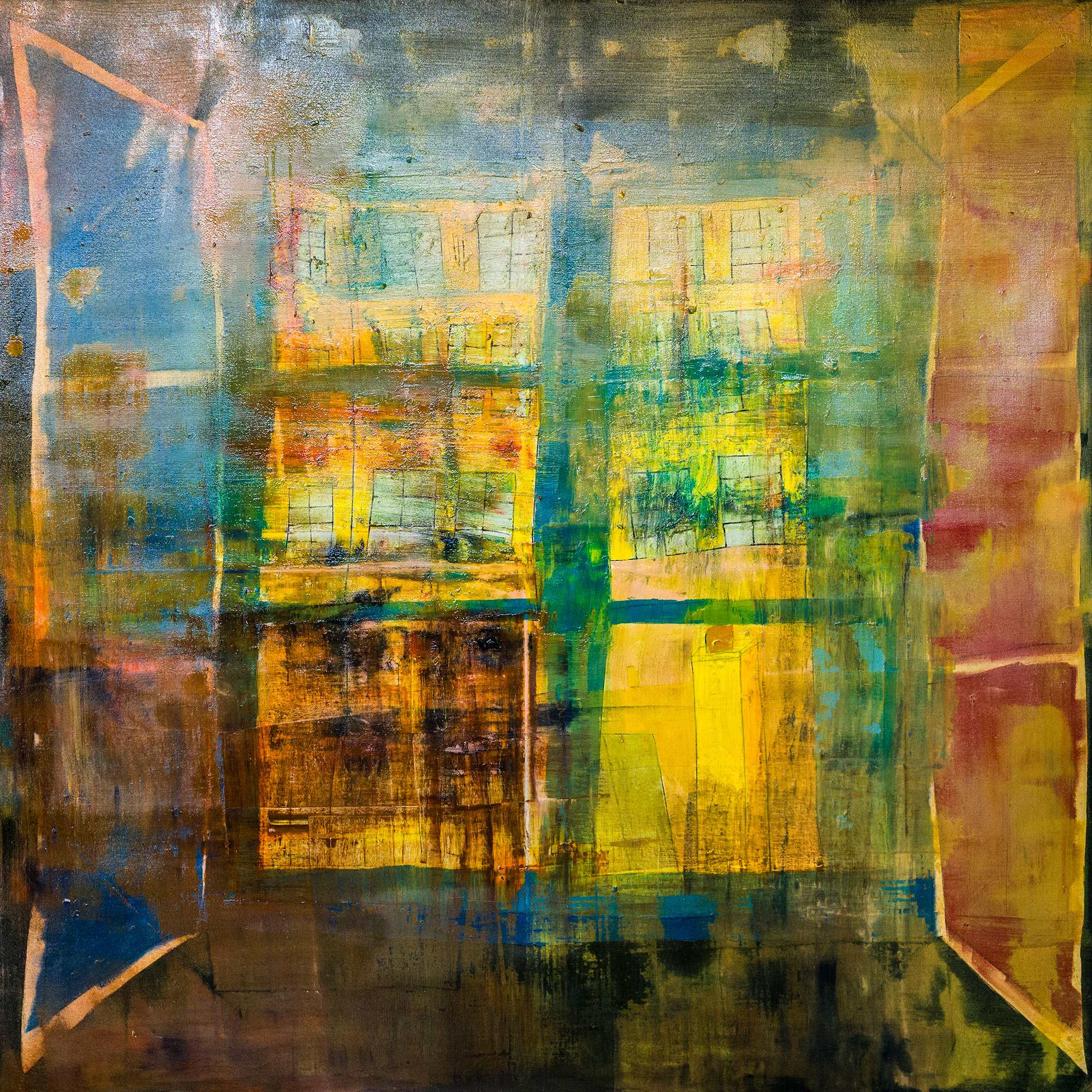
My painting Window to Seeing sits exactly on that line. You can still name what is there: two shutters swung open, a facade, a row of small windows. A machine would name them too. But nothing in it is observed. It is a window I saw in Picasso's home in Paris. I began the canvas in 2022 and finished it from memory four years later, and the perspective is impossible, the light comes from inside the walls, and the street below lets go of description altogether. On ArtGraph's Abstraction Quotient it reads 1: just past the border where a painting stops reporting a place and begins to remember one. It is a picture of the moment recognition starts to give way.
The turning point is language. An algorithm needs a specification, and a specification needs words: you can only automate what you can name. A representational painting can be specified, “a woman, seated, by a window,” and so it sits on the algorithm's side of the border. Past that border language begins to strain, and where language fails, only a person can go.
That is what the Abstraction Quotient measures. It asks how far a painting has travelled from what can be recognised and named. Put another way, it measures distance from the algorithm.
What the camera did
We have been here before. In 1839 photography arrived, and for the first time a likeness could be made by a procedure: point, expose, fix. The look of the world became repeatable and cheap. Twenty years later Baudelaire, reviewing the Paris Salon of 1859, attacked photography as the refuge of failed painters and the enemy of imagination. It was the first great essay on automation anxiety in art.
What happened next is the part worth remembering. Painters stopped competing with the camera on likeness. The Impressionists painted light and perception rather than objects. Cézanne painted how seeing is built rather than what is seen. By the 1910s Kandinsky, Malevich and Mondrian had left the object behind altogether. Mondrian's trees show one painter walking that road in four years, from Evening; Red Tree to the Compositions where the tree is gone and only the structure remains.
The camera did not replace painting. It freed painting to become abstract. It took over the part of painting that was recognition, the making of a convincing copy of what was already there, and painting answered by going where a procedure could not follow. Historians rightly argue about how much photography caused abstraction, alongside science, music, spiritualism and politics. But the pressure was real, and the answer was clear.
AI is now taking over a far larger share of recognition: not only likeness, but style, composition, and even the look of abstraction itself. The question painters faced after 1839 returns for everyone. What is left that only a person can do?
An old argument
None of the thinkers I lean on wrote about algorithms, but each of them describes these two forces under another name.
In 1908, three years before Kandinsky's first abstractions, Wilhelm Worringer published Abstraction and Empathy. He argued that art swings between two urges. The urge to empathy comes from feeling at home in the world and produces naturalistic art. The urge to abstraction comes from unease with the world and produces forms that pull away from it. Read today, algorithmic life is engineered empathy: a world made so comfortable that we stop questioning it. Abstraction is the urge that refuses that comfort.
In 1917 Viktor Shklovsky gave the problem its sharpest name: automatization. Habit swallows everything, he wrote, until we no longer see the things we use every day, and art exists to restore sensation, to make the stone stony, by making the familiar strange. An algorithm is automatization at industrial scale. Abstraction is the strongest form of what Shklovsky called estrangement.
Heidegger described the work of art as something that does not copy a world but opens one. He called it disclosure, and set it against technology's way of revealing everything as a resource to be used. Hannah Arendt called the human capacity to begin something unprecedented natality: the beginning that cannot be deduced from what came before.
The clearest map comes from the study of AI itself. Margaret Boden distinguished three kinds of creativity. Combinational creativity makes new combinations of familiar ideas. Exploratory creativity moves around inside an existing style or set of rules. Transformational creativity changes the rules, so that ideas become possible that were impossible before. Machines are now very strong at the first two. The move from Mondrian's tree to the grid, or from figure to field, is the third. Abstraction is transformational creativity made visible.
Two abstractions
A careful reader will object that algorithms are abstraction. Mathematics abstracts. A model abstracts. Every pattern is an abstraction from cases. That is true, and it is the part of this argument I can make only because I have lived on both sides of it.
The word names two movements that run in opposite directions. The first is abstraction as compression: the mathematician's and the engineer's abstraction, which strips the particular away to find the rule that covers many cases, so that the rule can be applied again. Its purpose is repetition, and every algorithm is built from it. The second is abstraction as disclosure: the painter's abstraction, which strips the familiar away to reach something no rule covers yet, so that it can be seen for the first time. Its purpose is the encounter that cannot be repeated.
Compression moves from many cases to one rule. Disclosure moves from the known to what has not yet been named. The first makes the world more predictable; the second makes it larger. I have built in the first and I paint in the second, and I have always felt they were one obsession. This is how they can be one obsession and still point in opposite directions. I am not against the algorithm, or against compression. I am saying that compression cannot do disclosure's work, however good it becomes, because it is designed to bring the new back to the known.
Four objections
Algorithms do surprise us. In 2016 AlphaGo's move 37 against Lee Sedol stunned the professionals watching; no human would have played it. The surprise was real, but it was found inside the fixed rules of Go. Nobody asked the machine to invent a new game. Abstraction is the invention of a new game.
Abstraction repeats itself too. It does. Styles harden, schools copy their founders, and critics have mocked whole waves of formulaic abstract painting. I have felt it in my own studio: a technique that once surprised me began to repeat itself, and I had to set it down. Abstraction is not safe from repetition. It is the practice of refusing it, and the refusal has to be renewed.
Representational art discloses new worlds too. It does: Caravaggio's light, Vermeer's stillness, a great photograph. That is why the line runs between recognition and disclosure rather than between figure and abstraction. Representation can disclose, but it carries the pull of the nameable subject. Abstraction is not the only road to disclosure, but it is the one with no detour around it.
We need the algorithm. We do, and I say so first. Let the machine gather, draft and check. Keep a person wherever the question is still forming. The argument is not abstraction instead of algorithm. It is knowing which one a moment needs: compression for what is known, disclosure for what is not yet known.
Why abstraction
Because only one of them can change us. An algorithm serves the person we have been, which is what it was trained on. Abstraction asks us to meet something we have no category for, and we leave with a new one. Growth needs something the pattern could not have predicted.
Because comfort compounds. In a world engineered for comfort, Worringer's abstracting urge has to be practised on purpose, or it weakens. People differ in how much abstraction they can bear; I suspect a life optimised for comfort quietly lowers that tolerance in all of us.
Because new language comes from there. Every word we have was once a disclosure that someone named. This month, in a conversation about Mondrian with strangers on Reddit, one person reached for a word for what a Rothko does to a body standing in front of it, and another offered it: physical weight. Algorithms can only use words that already exist. Abstraction is where the next words are made.
And because it is how we meet ourselves. Abstraction is the only access I know to living beyond the algorithmic world, and so the only access we have to the self: the part of each of us that is not yet a pattern.
A test
If abstraction is distance from recognition, a machine's recognition should fall as the Abstraction Quotient rises. Every painting in my catalog already carries an AQ. Ask an image-recognition model to name what each one shows, and record how sure it is. The prediction is simple: high confidence near AQ 0, where it can say a tree or a window, falling steadily toward AQ 5, where all it can say is abstract painting. If the curve holds, the Abstraction Quotient is, quite literally, a measure of distance from the algorithm. And as the machines improve, the border should move outward, the way painting moved after 1839.
An algorithm gives us more of the world we already have.
Abstraction gives us a world we did not know was there.
Ritu Raj is a painter, author and entrepreneur based in Phoenix, Arizona. His signature technique, Organic Movement, replaces the brush with thread. This paper joins his books The Unalgorithmic Self and The Shape of Seeing, and is part of the writing around the Taxonomy of Abstraction.
Sources: Wilhelm Worringer, Abstraction and Empathy (1908); Viktor Shklovsky, “Art as Device” (1917); Charles Baudelaire, “The Modern Public and Photography”, Salon of 1859; Martin Heidegger, “The Origin of the Work of Art” (1935–36); Hannah Arendt, The Human Condition (1958); Margaret A. Boden, The Creative Mind (1990; 2nd ed. 2004).