A few days ago I asked a question on r/ArtHistory. Why, more than a hundred years after Kandinsky and Malevich, is there still no shared language for abstract painting? Nineteen thousand people read it. Some answered with history, some with anger, a few with real generosity. One called it a hoax. One called it AI. Nobody said the question was wrong.
Reads onWhen Words Run Out · Taxonomy
I want to answer it properly here, with the help of the people who argued with me.
The gap
Painting that pictures the world has always found its words quickly. Pliny the Elder was writing about Apelles and Zeuxis in the first century. In 1435 Alberti gave painters a grammar of perspective, composition and light. A century later Vasari gave them a canon, a ranking and a story. From then on, a patron, a critic and a painter could stand in front of the same altarpiece and argue in the same language.
Abstraction arrived around 1910, and in the century since it has become one of the most valuable things a person can hang on a wall. A Rothko sold for $86.9 million in 2012. Yet stand in front of one with a friend and listen. Most of what gets said is I like it, or I don’t get it, or silence.
My father, K.B. Goel, was an art critic in Delhi for more than thirty years. His reviews and essays are collected in Critical Writings on Art, 1957–1998. I grew up around people who had words for painting. Even they, I think, would admit that the words thinned out exactly where the paintings stopped showing us things.
Who wrote the words we have
We are not without language. But look at who wrote it.
Kandinsky wrote Concerning the Spiritual in Art in 1911. Malevich wrote his Suprematist manifestos. Mondrian wrote about Neo-Plasticism. The richest writing on abstraction was produced by the painters themselves, to explain what they were doing and why.
The historians came next, and gave us movements, dates and influences. Then the critics tried to rebuild their old authority. Clement Greenberg, more than anyone, argued that modern painting should be about its own flatness. In doing so he wrote a new canon, a set of rules for what painting ought to do.
So we have the maker’s language, the historian’s language and the critic’s language. What we do not have is the viewer’s language. Nobody wrote words for the person standing in front of the painting, for what actually happens to them there.
Why the old road closed
A Renaissance and Baroque historian, in a first semester teaching Modernity, gave me the best answer in the thread. The language of earlier painting, they pointed out, was made in one place. The Academy, and writers like Vasari, van Mander and Winckelmann, defined what art should be and how we should receive it.
Then two things happened at once. Photography took over the job of likeness, and the Academy lost its authority to say what art was. There was no longer a single room where the words could be made. Each abstract movement spoke for itself, often against everyone else.
Then history loaded the paintings before anyone had plain words for them. During the Cold War, Abstract Expressionism travelled through Europe as a picture of American freedom, and some of that cultural traffic was quietly funded by the state. The language around these paintings became grand very quickly: freedom, the void, the infinite. Grand words are hard to use on an ordinary Tuesday in a gallery.
The objections, taken seriously
The thread gave me every objection to my question, and they deserve answers.
It refuses words by design. Rothko said “silence is so accurate.” He also told museums exactly how dim to keep the lights. The silence was very precisely arranged. Refusing to explain a painting is not the same as refusing to let people talk about what it did to them.
You just feel it. We feel music too, and we still have tempo, key and crescendo. Nobody believes the word minor ruins a sad song. Words don’t replace the feeling. They let two people compare what happened to each of them.
It’s the emperor’s new clothes. One commenter, who said he had spent twenty years as a critic, called abstraction a swamp. His best point was this: we can hear when a violinist plays badly, so why can’t we say when an abstract painting fails? I think he is right about the symptom and wrong about the cause. We can hear bad playing because there is a shared vocabulary for playing. Where that vocabulary is missing, judgment falls back on money, reputation and who is in the room. The answer is not to abandon abstraction. It is to build the words that let someone say this one doesn’t work, and here is why.
The process tells you everything. Another commenter wrote beautifully about de Kooning, who called himself a “slipping glimpser” and thinned his paint so it could keep up with his thought. As a painter, I agree that process is the most honest way in. But process language describes how the painting was made. I am still looking for language that describes what happens to the person looking at it.
Nobody wrote words for the person standing in front of the painting.
We have done this once before
Someone in the thread asked, a little impatiently: what happens to a person looking at a sunset, or a storm?
It is the right question, because that is exactly where we once built the words. In 1757 Edmund Burke wrote a whole treatise on what happens to a person facing a storm, a cliff edge, an ocean. He called it the sublime, and he took it apart: astonishment, obscurity, vastness, a pleasure mixed with fear. He gave ordinary people a way to describe an experience that had no object to point at.
In 1948 Barnett Newman wrote an essay called “The Sublime Is Now” and tried to carry that vocabulary into abstract painting. The instinct was right. But the sublime is one word for one kind of encounter, and abstraction holds hundreds of kinds. The vocabulary never grew past its first word.
Words from the viewer’s side
Here is where the thread brought me. The language that abstraction is missing was never going to come from above. Not from an Academy, not from a critic, not from a manifesto. Every attempt from above ended up as a canon, a set of rules about how a painting should be received.
If abstraction insists on the experience of seeing, then its vocabulary has to be built from the side of the person seeing. Not rules for how to look, but words for what happens when you do. Where the eye goes first. Whether the surface pulls you in or holds you off. Whether the color warms the room or cools it. Whether the painting resolves, or stays open.
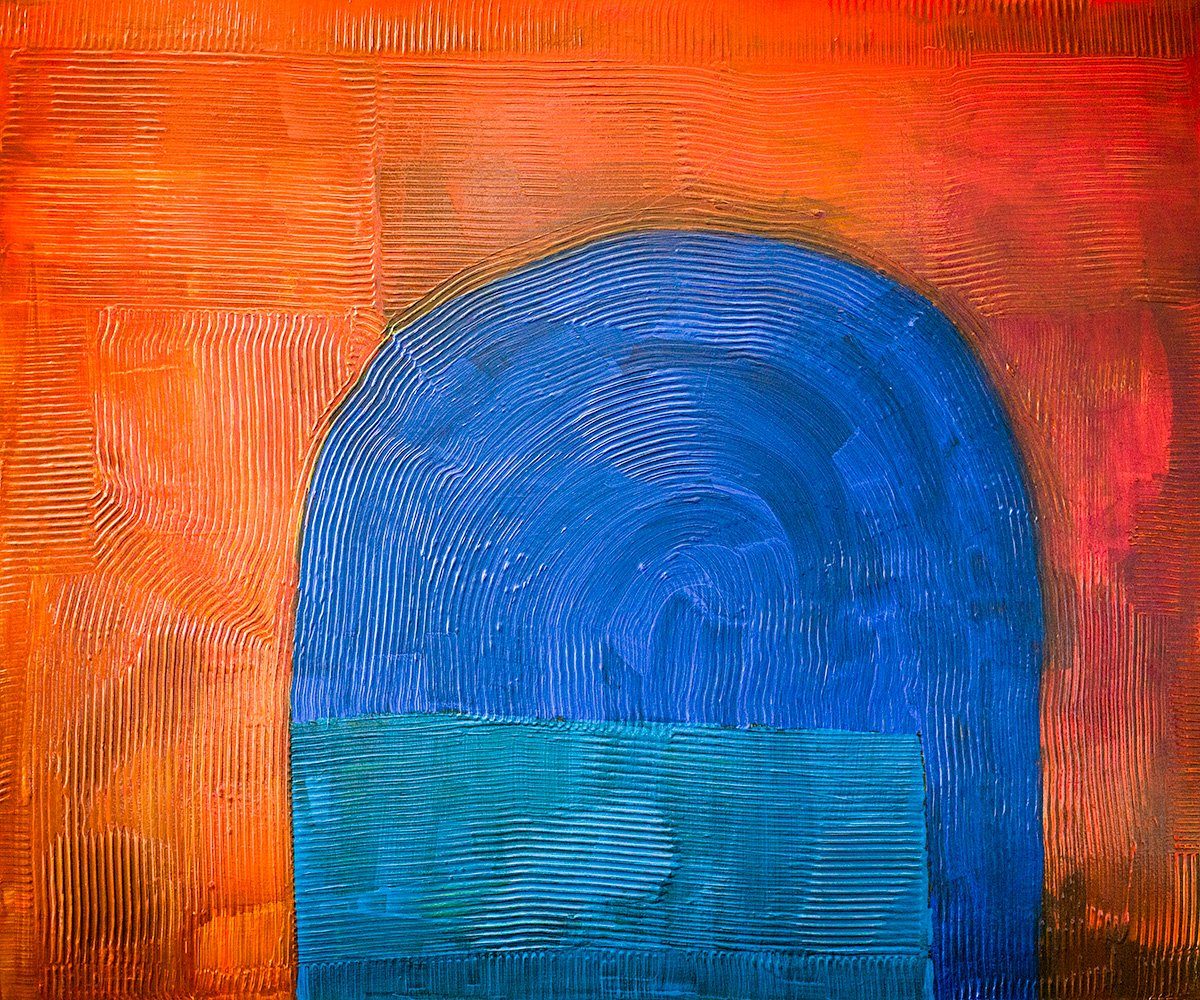
A few weeks ago a senior art historian came to my studio. I loved the way she looked. She stood in front of my abstract paintings as if they were old representational oils, the kind she had spent a lifetime reading, and she read them the same way. Slowly, passage by passage. She stayed longest with The Blue Sanctum. Then she began pointing to the places where I had stopped. Where a gesture ended and I had decided to leave it. That is very hard to see in an abstract painting, and almost nobody sees it. She found it because she had brought a language with her, and she made it fit. She found her own way in.
That afternoon told me the words are possible. She just had to carry hers in from somewhere else.
This is the work I have been doing for the last few years, alongside the painting. I call it ArtGraph: a system and language for encountering abstract art. It does not tell anyone what a painting means. It gives the encounter a shape, so two people can compare what happened to them.
It is only a beginning.
But a language has to start somewhere,
and I would rather it started
in front of the painting than above it.
Thank you to everyone on r/ArtHistory who argued with the question, especially the historian teaching a first semester of Modernity. Several of the best ideas here came from them.
Ritu Raj is a painter, author and entrepreneur based in Phoenix, Arizona. His signature technique, Organic Movement, replaces the brush with thread. He is the author of The Shape of Seeing and The Unalgorithmic Self (American Real Publishing, 2026), and this essay is part of the writing around the Taxonomy of abstraction.