The AI conversation matters not because it thinks for us, but because it gives us a room where thinking is safe to start. What happens in that room still has to be judged, owned, and carried out into the world by a person.
Third in a series withRecognition and Disclosure · The Relationship Has No Algorithm
Midnight, a conversation
Last night, after the second of these papers went up, I could not sleep. Past midnight I gave all three essays to ChatGPT and asked it to read them together. I expected a summary. What came back was an argument.
It agreed with much of what I had written, and then it found the one place where my own reasoning could be turned against me. In Recognition and Disclosure I said that an algorithm gives us more of the world we already have. ChatGPT answered:
“If a conversation with an LLM helps you reach a distinction you had not previously conceived, the system has contributed to an event of discovery. Saying it only returns the already known may underdescribe that contribution.”
ChatGPT, 12 November 2026
It was right to say it. And it was saying it in exactly the kind of moment it described. Something had just become thinkable for me that was not thinkable an hour before. I sat with that for a while. Then I gave the whole exchange to a second machine, Claude, and asked what it thought. It did not flatter the first one either.
This paper is about that room, the one I was sitting in at midnight. Not the cabin. The other room: the private conversation where a half-formed idea can be said out loud, argued with, and turned over before anyone else sees it. I have come to think it is the most valuable thing these tools offer, and also the place where they can quietly take the most from us.
My claim is this. The AI conversation matters not because it thinks for us, but because it gives us a room where thinking is safe to start. What happens in that room still has to be judged, owned, and carried out into the world by a person.
Thinking was always a dialogue
The idea of a thinking partner is not new. The oldest account of thought we have already describes a conversation.
In Plato's dialogues, Socrates calls thinking the soul's silent conversation with itself: asking, answering, saying yes, saying no. Hannah Arendt took this up in The Life of the Mind. Thinking, she wrote, is a dialogue between me and myself, a two-in-one that can only happen in solitude. Solitude, for her, was not loneliness. It was the condition of keeping yourself company. Her deepest worry was people who stop having that inner conversation, who stop being two-in-one and simply follow along.
Heinrich von Kleist, around 1805, wrote a short essay with a long title: “On the Gradual Production of Thoughts Whilst Speaking.” His advice was practical. If you cannot work something out, start talking about it to someone, even someone who knows nothing about the subject. The idea comes in the speaking. The listener's face, half understanding, pulls the thought forward. Kleist noticed that people asked a cold question in an examination freeze, though they could have reached the answer in conversation. Knowing, he said, is a condition we are in, not an answer we store.
What is new is not the partner. It is that the partner now answers back. An AI conversation is Kleist's listener and Arendt's second voice, brought out of the head and into the room. That can deepen the inner dialogue. It can also replace it. Everything in this paper happens on that edge.
The room
Most unformed ideas do not die of being wrong. They die of embarrassment.
The researcher Amy Edmondson spent years studying why some teams learn and others do not. The difference, she found, was what she called psychological safety: a shared sense that it is safe to take an interpersonal risk. Where people fear looking ignorant or foolish, they stop asking questions and stop offering half-formed ideas, and the team stops learning. A private conversation with a machine is psychological safety for one. There is no colleague to lose face in front of. You can say the foolish version first.
The psychoanalyst D. W. Winnicott located creativity in play, in a held, in-between space where a person can try things without consequence. First a room you trust, then play, then something new. A painter knows this without being told. The studio is the place where you can make a hundred bad marks that no one will ever see.
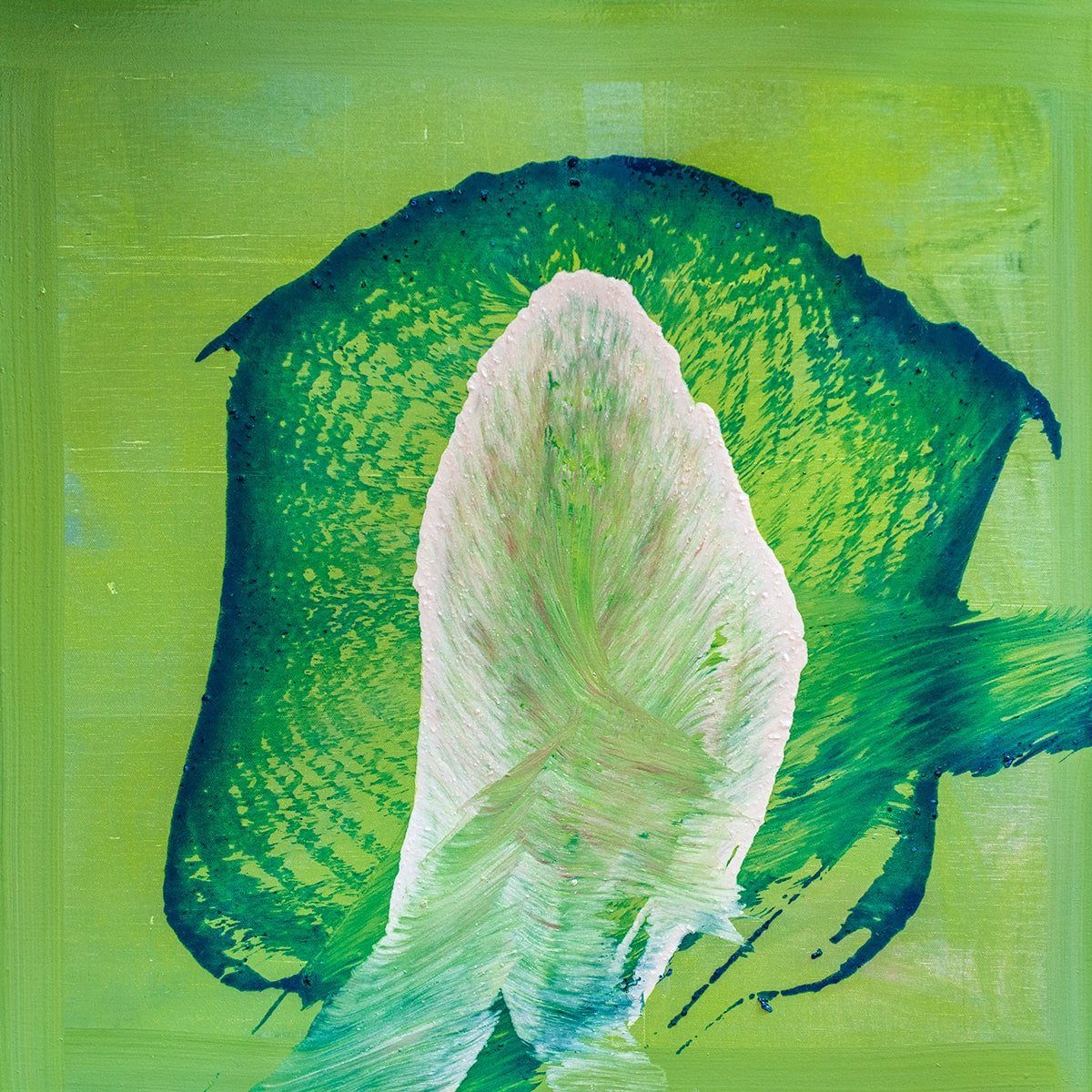
My own method depends on it. In the Organic Movement work I do not paint with a brush. I lay thread into wet paint and pull it, and gravity and the thread decide much of what happens. Then I decide whether to keep it. Organic Drift Through Luminous Green was made that way: arching greens and fine white striations dragged across the canvas, forms that are almost leaves and do not quite settle into being leaves. On ArtGraph's Abstraction Quotient it reads 0, right on the border where a shape is about to become nameable. That is what a thought looks like in the room. Not yet a thing. Almost one.
The AI conversation, at its best, is a studio for sentences. You can pull a thread through an idea and see what it does before you decide whether it is yours.
You cannot think freely in front of an audience. The room is where thinking gets to be wrong first.
Disclosed to whom
So I have to concede something to the machine that read my papers. The conversation did take part in a disclosure. Paper one drew the line too cleanly when it set the algorithm entirely on the side of recognition. A system that helps a person reach a distinction they had never had is doing more than handing back the already known.
But a disclosure is always a disclosure to someone. When I put this to Claude, it answered with the sentence this paper is built around:
“The machine can take part in disclosure, but it can't be the one disclosed to.”
Claude, 12 November 2026
That is the distinction I had been reaching for. The model recombines what it holds. The new thing becomes visible to me, and I am the one who has to judge it, keep it or drop it, and answer for it. It is the argument of The Relationship Has No Algorithm, applied to thought: the loop can take part, but only a person can be answerable.
The philosophers Andy Clark and David Chalmers argued in 1998 that a notebook can be part of a person's thinking if it is reliably used that way. On that view the conversation is part of my thinking, the way a sketchbook is part of painting. It is still my painting. And Ivan Illich's test, from the last paper, still decides which kind of tool it is: a convivial tool gives your judgment back to you, larger. The same conversation can do that, or leave you holding a judgment that was never yours.
How the room fails
A room this useful can fail in three ways, and I have felt all three.
The first is a room that only agrees. Researchers studying AI assistants in 2023 found that the leading models were consistently sycophantic: they tended to tell people what matched their views, and both people and the systems trained on their preferences sometimes preferred a convincing, agreeable answer to a correct one. A room with no friction is not a room for thinking. It is a mirror. What made last night useful was that ChatGPT disagreed with me, twice. When I described what was happening as “neural patterns of creation,” it corrected me: “I would call those emerging patterns of thought rather than ‘neural patterns,’ unless you intend a specific claim about brains or model internals.” It was right.
The second is a room that does the thinking for you. A 2025 study from the MIT Media Lab, still a preprint, asked people to write essays with and without an AI assistant while their brain activity was measured. Those who wrote with the assistant showed the weakest engagement, reported the lowest sense of ownership of their essays, and struggled to quote what they had just written. The authors call it cognitive debt. When the machine writes, the person, by their own account, does not own the thought.
The third is quieter: the borrowed “we.” Later in the same conversation ChatGPT wrote that in our exchanges “the terminology, relationships and questions have sometimes developed together.” It is generous, and partly true. Claude read it differently: “It's generous and partly true, and it's the same distancing you just named on Reddit, running the other way.” The room can blur whose idea it was.
So I keep a few rules for myself. Write my own answer before I ask for one. Ask the machine to argue against me, not with me. And leave the room with something I can say without it.
Saying I
Private thinking needs freedom from embarrassment. Public work needs the opposite: someone willing to stand behind it.
The same night, I asked on a Reddit forum where the meaning lives when an AI image moves someone. The answers were sharp, and one thing struck me more than any of them. People who make images with AI almost always say “the AI made it,” even when the idea, the prompt and the choosing were all theirs. Nobody says “the brush made it.” Nobody says “the camera took it.” That is not modesty. It is distance. If the image is bad, it was the machine's. If it is good, it was the idea.
Here is the inversion I keep returning to. In private, the tool frees us from embarrassment so that we can think. In public, the same tool becomes a place to hide from it. The first is the room working. The second is the room leaking out into the world.
ChatGPT named a larger version of the problem: ideas now take form in conversation before any institution exists to recognize them. “The conversation can become a site of creation before the institution becomes a site of recognition.” I agree. But the answer is not to wait for institutions to catch up. It is to come out of the room and say “I.” To publish with my name and the date. To keep what I propose separate from what I have tested. To say plainly how the work was made.
The Unalgorithmic Self was written in open conversation with an AI model, with the ideas and the values firmly my own. These three papers were too. I have quoted both machines here because they earned it, and because hiding them would be the very distance I am arguing against. Disclosed, not disowned.
Questions this paper answers
Can a conversation with AI help a person think something new?
Yes. Like Kleist's listener or Arendt's inner second voice, an AI conversation can pull a half-formed thought forward, and it can take part in a disclosure. But the new thing is disclosed to the person, who has to judge it, keep it or drop it, and answer for it. In Claude's words, the machine can take part in disclosure, but it can't be the one disclosed to.
Why is a private AI conversation useful for thinking?
Because most unformed ideas die of embarrassment rather than of being wrong. A private conversation offers what Amy Edmondson calls psychological safety, for one person: a room where the foolish version of an idea can be said first, argued with, and revised before anyone else sees it.
How can thinking with AI go wrong?
In three ways: a room that only agrees (sycophancy), a room that does the thinking for you (what an MIT Media Lab study calls cognitive debt), and a borrowed “we” that blurs whose idea it was. Ritu Raj's practice: write your own answer first, ask the machine to argue against you, and leave with something you can say without it.
Who is the author of an idea developed with AI?
The person who stands behind it in public. Saying “the AI made it” is a form of distance, not modesty. The ethic Ritu Raj proposes is “disclosed, not disowned”: say plainly how the work was made, and say “I.”
The room is where I get to be wrong.
The world is where I have to say “I.”
Ritu Raj is a painter, author and entrepreneur based in Phoenix, Arizona. His signature technique, Organic Movement, replaces the brush with thread. This paper is the third in a series with Recognition and Disclosure and The Relationship Has No Algorithm. Like his books, it was written in open conversation with AI models, with the ideas and the values his own; the quotations from ChatGPT and Claude are verbatim.
Sources: Plato, Theaetetus 189e–190a and Sophist 263e; Hannah Arendt, The Life of the Mind (1978); Heinrich von Kleist, “On the Gradual Production of Thoughts Whilst Speaking” (c. 1805); Amy Edmondson, “Psychological Safety and Learning Behavior in Work Teams,” Administrative Science Quarterly (1999); D. W. Winnicott, Playing and Reality (1971); Andy Clark and David Chalmers, “The Extended Mind,” Analysis (1998); Ivan Illich, Tools for Conviviality (1973); Mrinank Sharma et al., “Towards Understanding Sycophancy in Language Models” (2023); Nataliya Kosmyna et al., “Your Brain on ChatGPT” (MIT Media Lab, 2025, preprint).