A relationship is not an algorithm, and neither is an abstract painting. Both resist computation because they share one form: no object, meaning made between two, held open, practised rather than owned. Representation tells you who someone is. Abstraction is how you meet them.
Fourth in a series withThe Relationship Has No Algorithm · The Private Room
Not an algorithm
Begin with what a relationship is not. It is not an algorithm. An algorithm takes inputs, follows rules and returns an output that could have been predicted from the rules. We now try to run our relationships this way: apps that score compatibility, feeds that learn which version of a friend keeps us scrolling, suggested replies for the hard conversation. Some of it helps. None of it produces the thing itself. Put a relationship into an algorithm and what comes out is a transaction around it — a match, a reminder, a message drafted on our behalf. The relationship stays outside, waiting for two people to show up.
Abstract painting meets the same wall. Pattern can be generated endlessly: by rule, by code, by a model trained on a century of canvases. A machine can produce something that looks abstract in a second. But a pattern that generates the look of abstraction is not abstraction, any more than a compatibility score is love. It has the appearance of the form without the encounter that makes it one. Abstraction is not merely the absence of a recognisable subject. It is the presence of something you could not have predicted.
So if neither a relationship nor an abstract painting can be computed, what kind of thing is each of them?
Try to photograph a friendship. You can photograph two friends, a table, the wine between them, the light. You cannot photograph the friendship. It is real, it has weight, it can be broken, and yet it has no surface. It exists only between.
An abstract painting poses the same difficulty in reverse. It has a surface and nothing else. There is no subject behind it to recognise, no story to step into. People stand in front of it and say, “I don’t get it,” as though the painting were withholding an object. It isn’t. What it offers is not an object but an encounter, and the encounter happens between the canvas and the person looking.
Both escape the algorithm for the same reason. The claim of this paper is that these are not two difficulties but one. A relationship is an abstract form. An abstract painting is a relationship made visible. Both are composed of relations rather than things; both are completed only by the other party; both stay open; both are practised rather than owned. Understanding one is a way of understanding the other.
I come to this as a painter. For six years I have made large abstract canvases, many of them by pulling string through wet paint, a method in which I guide the line but cannot command it. For longer than that I have been in relationships, with a wife, with friends, with the painters my father wrote about in Delhi, with the companies I built. The longer I have done both, the less I can tell where one practice ends and the other begins.
What abstraction is: the art of relations
The word comes from the Latin abstrahere, to draw away. In ordinary speech this has made “abstract” mean remote, theoretical, cold. In painting it means something nearly opposite. To abstract is to draw away the recognisable object so that what remains can be seen: colour against colour, weight against weight, edge against edge. What remains, in other words, is relation.
The painters who built abstraction said this plainly. Piet Mondrian, in a statement published in 1945, the year after his death, put it in six words: “Everything is composed by relation and reciprocity.” He went further: “Color exists only through another color, dimension is defined by another dimension.” His grids are not pictures of anything. They are relationships held in balance, and Mondrian believed the work was to create such relationships “and attempting to balance them in art and in life.” He did not keep the canvas and the life in separate rooms.
Josef Albers spent his teaching life proving the same point with paper squares. Interaction of Color (1963) opens with a sentence that has unsettled painters ever since: “In visual perception a color is almost never seen as it really is — as it physically is. This fact makes color the most relative medium in art.” Place a grey on yellow and it leans violet; place the same grey on blue and it warms. “One and the same color evokes innumerable readings.” Nothing in an Albers exercise has an identity of its own. Every colour is what it becomes beside another.
Read those sentences again with people in mind. A person is almost never seen as they really are. One and the same person evokes innumerable readings. We are quieter beside some people and louder beside others, softer in one friendship and sharper in another. Abstraction did not invent this truth about relation. It isolated it, removed everything else, and put it on a wall where it could be looked at.
What a relationship is: the between
In 1923 the philosopher Martin Buber published I and Thou, a short book about two ways of standing toward the world. In the first, which he called I–It, we meet the other through categories: same or different, useful or not, this kind or that kind. It is the stance of classifying, measuring, using. Buber did not despise it. Science and work depend on it. But it is a relation to a thing.
In the second, I–Thou, the other is met whole. It is, in one summary of Buber’s thought, “the pure encounter of one whole unique entity with another,” in which the other is not “subsumed under a universal.” Neither party is an object. Each is a pole, and the life of the relation lies at neither pole but “in the between” — das Zwischen. A relationship, for Buber, is not something two people have. It is something that happens between them, and only while they stand in it.
Two details in Buber matter here. First, he placed artistic creation inside this encounter. He wrote of “the encounter with form that occurs in moments of artistic inspiration,” and of form that “assumes communication with an interlocutor.” The artist does not manufacture form; the artist meets it. Second, he was clear that every Thou can slide back into an It. The beloved becomes a role, a habit, a profile. The painting becomes a decoration. Relation is not a possession but a recurring act.
Buber’s distinction is the same one abstraction draws on the wall. Representational art invites I–It: that is a sunflower, recognised, filed, passed. Abstract art refuses the category. There is nothing to file, so the only way in is encounter. In the language of The Relationship Has No Algorithm: you can model a person, but you cannot meet a model. Modelling is I–It. Meeting is I–Thou.
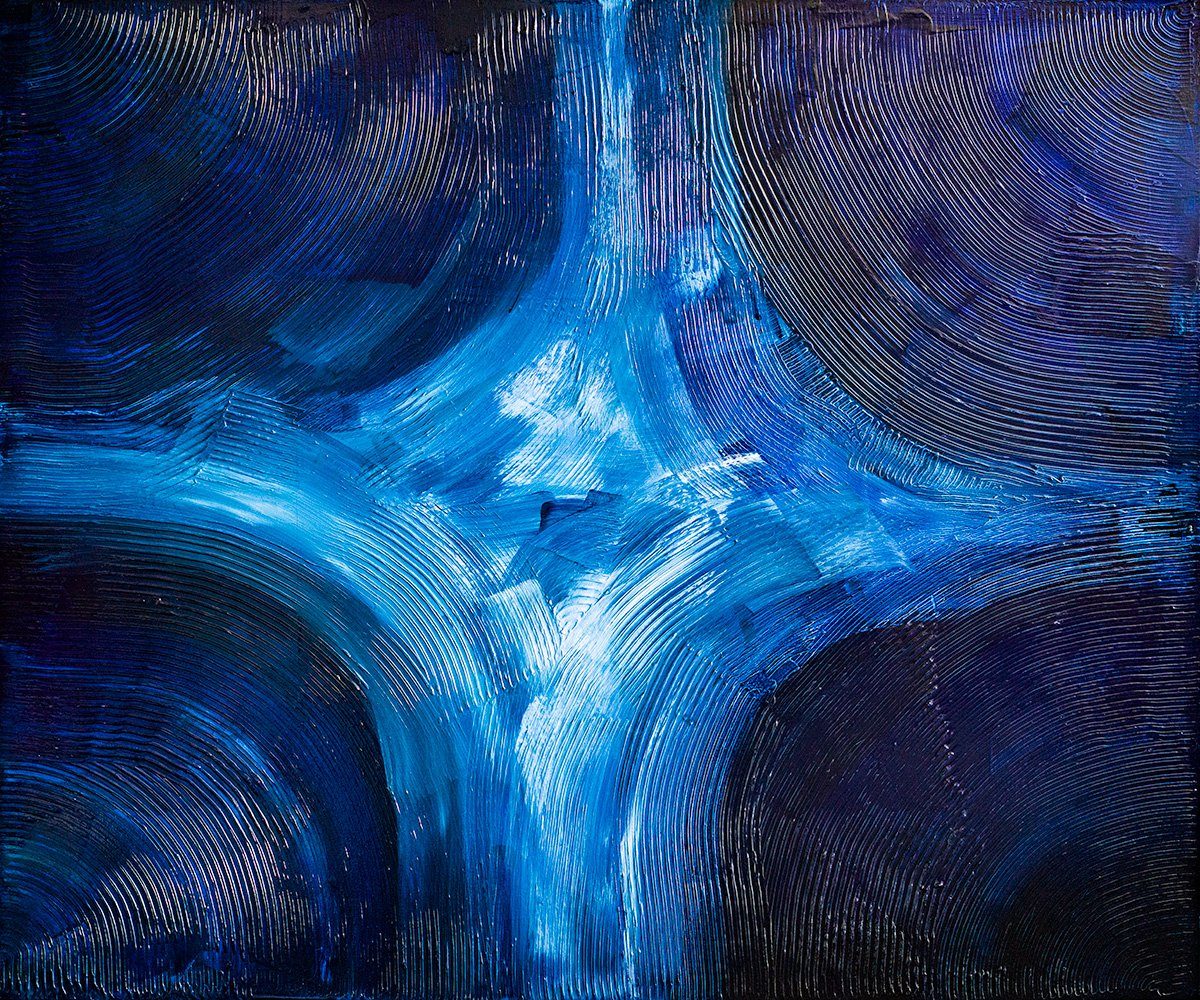
The shared form
Put the two side by side and the correspondence is not loose. It holds at five points.
| An abstract painting | A relationship | |
|---|---|---|
| No object | No subject to recognise; only colour, form and their relations | No thing to hold; only two people and what passes between them |
| Identity by relation | A colour is what it becomes beside another (Albers) | A person is who they become beside another |
| Completed by the other | Unfinished without the viewer’s response (the beholder’s share) | Unfinished without the other’s response; one person cannot have it alone |
| Held open | Not a riddle to solve; pleasure comes without resolution | The other is never solved; understanding comes without closure |
| A practice, not a possession | The residue of a practice, renewed in each encounter | An art practised daily (Fromm), lapsing when it is not |
The first two points are about structure: what the form is made of. The last three are about life: how the form is entered, sustained and lost. The sections that follow take them in turn, because each is supported by more than analogy.
The beholder’s share and the other’s share
At the turn of the twentieth century the Viennese art historian Alois Riegl argued that a painting is not complete on the wall. The artist makes it; the beholder responds; the work exists in both. Ernst Gombrich later named the viewer’s contribution “the beholder’s share,” and in our own time the neuroscientist Eric Kandel has given it a biological account. “Without the response of the beholder,” Kandel writes, “art is incomplete.” The brain, in his phrase, “is not a camera but a creativity machine.” Each of us brings our own experience to what we see — what Kandel, following Helmholtz, calls top-down information — “and therefore each responds to art in a different way.”
Kandel’s further point is the one that matters here. The less a picture gives, the more the beholder must bring. A portrait does much of the work for you. An abstract canvas does almost none, so the beholder’s share rises until it carries much of the work. This is the argument of Kandel’s Reductionism in Art and Brain Science (2016). Abstraction is the form of painting in which the viewer’s part is largest. It is, structurally, the most relational of the visual arts.
Mark Rothko understood this without the neuroscience. “A picture lives by companionship,” he wrote, “expanding and quickening in the eyes of the sensitive observer.” He went on to say that a painting dies without that companionship, and that sending one out into the world is a risky act. His word was not viewer, audience or market. It was companionship: the vocabulary of friendship, not of exhibition.
A relationship works the same way. What I bring to my wife is not the whole of what passes between us; what she brings completes it, and what she brings I could never have supplied. The other’s share is not a contribution to something I already have. It is half of the thing itself.
Held open: the refusal to solve
The most common complaint about abstract painting is that it won’t explain itself. The research suggests that this is precisely why people come to love it.
In 2015 Claudia Muth and colleagues at the University of Bamberg showed 29 people with no art training seventeen ambiguous works of twentieth- and twenty-first-century art. Participants rated how much they liked each work, how interesting and moving they found it, how ambiguous it seemed, and how solvable. The result ran against the assumption that people want art to be easy: “the higher the subjectively perceived degree of ambiguity within an artwork, the more participants liked it.” Solvability had no significant link to liking, and was negatively linked to interest. People reported moments of insight that gave them pleasure — but those insights came “without resolving” the ambiguity. The researchers’ conclusion is a sentence any long marriage could have written: “Artworks are not riddles to be solved via analytic steps.”
Neither are people. The early stage of a relationship is often an attempt to solve the other: to learn their history, predict their moods, complete the picture. The relationships that last are the ones in which that project quietly fails. The other remains more than you know, and the moments of understanding — a look across a dinner table, a sentence finished by the wrong person — arrive without closing the question. Those moments are the aesthetic insights of a shared life.
I have elsewhere called the capacity this requires abstraction tolerance: the ability to stay with what does not resolve, without forcing it into an answer or walking away. It is built the same way in front of a canvas and across a table. It is also, I suspect, the capacity most at risk in a culture that resolves everything for us before we have had to wait.
Standing in: love and painting as practices
In 1956 Erich Fromm published The Art of Loving, and its first move was to take the title literally. “The first step to take,” he wrote, “is to become aware that love is an art, just as living is an art.” To learn it, “we must proceed in the same way we have to proceed if we want to learn any other art”: with theory, with practice, and with the willingness to make it a matter of ultimate concern.
Fromm’s sharpest distinction is between two verbs. We speak of falling in love, as if love were an accident that happens to us. Fromm proposed that the enduring state is better called standing in love. Falling is passive and brief. Standing is an act, renewed.
That is also the difference between seeing an abstract painting and looking at one. You can fall into a painting for a moment, struck by a colour across a room. To stand in front of it — to let it work, to come back, to see it change as you change — is a practice. And the painting itself is the residue of a practice. Nothing on my canvases depicts the hours that made them, but every mark records a decision, an accident, a correction, a decision to leave the accident alone. The work is not a picture of something; it is what remains of a long attention.
A relationship is the same kind of residue. Nothing in a marriage depicts it. What exists is a long accumulation of small acts — a messy day, and then two people making a little dinner together — and the form those acts have taken over time. You cannot buy that form, inherit it, or keep it by owning it. You can only go on making it.
What the brain suggests
The correspondences so far are philosophical and psychological. There is also a modest piece of physical evidence.
In 2011 the neurobiologist Semir Zeki and his colleague Tomohiro Ishizu published “Toward a brain-based theory of beauty” in PLoS One. Subjects looked at paintings and listened to music while their brains were scanned. Experiences they rated as beautiful, whether visual or musical, engaged the same region: the medial orbitofrontal cortex, part of the brain’s pleasure and reward system. Activity in another region, the caudate nucleus, rose with the visual beauty of paintings. The caudate had earlier been found to correlate with romantic love, in work Zeki carried out with Andreas Bartels. The authors read this as a possible neural correlate of “the relationship between beauty and love.”
This needs to be held lightly. A shared brain region does not make two experiences the same experience, and imaging studies measure correlation, not meaning. What the finding does show is that the old intuition linking beauty and love is not only poetic. The brain answers both through overlapping circuits of reward and attachment. When someone says a painting moved them the way a person does, they may be describing their own neurology more precisely than they know.
The algorithm as representation
If a relationship is abstract, then the dominant technology of our time is representational. An algorithm meets a person as a profile: a set of past choices, from which it predicts the next. It returns more of what resembles what we chose before. This is I–It at industrial scale, and it is often useful. It finds the song, the route, the toothbrush. But it can only represent. It cannot meet.
The risk is not that machines will become relational. It is that we will begin to treat each other as they treat us: as profiles to be predicted, matched and optimised. We saw it at the start of this paper, in the apps that score us and the feeds that learn us. The form of the relationship begins to look like the form of the recommendation. Comfort becomes repetition, and repetition sells itself.
Abstraction moves the other way. It offers no profile to match and no next item to predict. It asks the viewer to arrive without a category and to stay without an answer, which is exactly what a relationship asks. In that sense abstract art is not a retreat from human connection but a training ground for it: a place where the capacities relationships need — attention, patience with the unresolved, willingness to be changed by what you meet — are exercised on a surface that cannot be modelled in advance.
This is also what ArtGraph, the language system I have built for encountering abstract art, was quietly designed to honour. Six of its dimensions read the painting: texture, contrast, form, abstraction quotient, colour range and palette. A machine can measure those, identically, every time. Three further fields, the EncounterGraph, read the encounter: space, transformation and feeling. Those no machine can fill, because they describe what happened between a particular person and a particular painting at a particular hour. ArtGraph, it turns out, is a notation for a relationship. Its line between what can be measured and what must be met is the same line this paper has been drawing.
Objections and limits
Five objections deserve an answer.
Relationships are concrete, not abstract. They are made of bodies, meals, money, chores and illness. To call them abstract can sound like an evasion of all that. But “abstract” here does not mean unreal or detached. It means not reducible to a picture or a profile. An abstract painting is also entirely physical — paint, string, canvas, gravity — and still cannot be summarised by naming its materials. The same is true of a marriage.
The word has two meanings. In everyday speech “abstract” means theoretical; in art it means non-representational. This paper uses only the second. The confusion is worth naming because a reader who hears the first meaning will hear the claim as cold, when it is the opposite.
This is not relational aesthetics. In 1998 the curator Nicolas Bourriaud described a body of work whose point of departure is “the whole of human relations and their social context”: artists who serve meals, host gatherings, stage encounters. That is art made out of relationships. The claim here is different. It is that relationships, wherever they occur, already have the form that abstract painting makes visible.
Some abstract art is made by algorithm. Sol LeWitt’s wall drawings are written instructions carried out by other hands, and artists have generated abstract images with computers since the 1960s. If abstraction can come from a rule, the opening claim of this paper seems to fail. But LeWitt’s instructions never produce the same drawing twice: each draftsman, wall and light differs, and the work lives in that drift between the rule and its making. And whatever produced the surface, the encounter in front of it is not computed. A rule can make a pattern. It cannot make the moment someone stands before the pattern and is changed. The algorithm can supply the canvas; it cannot supply the between.
Analogy is not identity. Five correspondences make a strong case for kinship. Strictly, they do not prove that a relationship and a painting are one thing; a canvas does not love you back. What they share is a form — relational, completed by the other, open, practised — and it is the form, not the substance, that this paper claims is the same.
Conclusion
This paper began with what a relationship is not: an algorithm. It ends with what it is. A relationship is the most abstract thing we make. It has no object, only a between.
Abstract painting took that structure and set it on a wall. Mondrian and Albers removed the recognisable world until only relation remained, and found that nothing in it had an identity of its own. Buber found the same thing in human life: the real meeting happens neither in me nor in you but between us, and it lasts only while we stand in it. The psychology of looking adds that the viewer completes the work, and that the pleasure of art does not depend on solving it. Fromm adds that love is not found but practised. The neuroscience, held lightly, adds that the brain answers beauty and love in overlapping ways.
Taken together, these say one thing. Representation tells you who someone is. Abstraction is how you meet them. In a century that will represent each of us more completely than any before it — as profiles, predictions, models — the capacity to meet without first representing may be the one we most need to protect. Abstract painting is one of the few places left where that capacity is practised in public, on purpose, every day.
We do not solve the people we love. We stand in front of them, the way we stand in front of a painting that will not explain itself, and we come back.
Questions this paper answers
Can a relationship be turned into an algorithm?
No. An algorithm takes inputs, follows rules and returns a predictable output. Applied to a relationship it produces a transaction around it, such as a match, a reminder or a drafted reply, but never the relationship itself, which exists only between two people who show up.
Why does Ritu Raj call relationships an abstract form?
Because a relationship has no object you can point to. Like an abstract painting it is made of relations rather than things, it is completed only by the other party, it stays open rather than resolving, and it is practised rather than owned. Representation tells you who someone is; abstraction is how you meet them.
What do Mondrian and Albers have to do with relationships?
Both made relation the subject of abstraction. Mondrian wrote that everything is composed by relation and reciprocity; Albers showed that a colour is almost never seen as it really is, because it changes beside every other colour. People are the same: we become who we are beside one another.
Can abstract art be generated by an algorithm?
A rule or a model can generate a pattern that looks abstract, and artists such as Sol LeWitt worked from written instructions. But no two executions of a LeWitt instruction are the same, and the encounter in front of any surface is not computed. The algorithm can supply the canvas; it cannot supply the between.
We do not solve the people we love.
We stand in front of them, and we come back.
Ritu Raj is a painter, author and entrepreneur based in Phoenix, Arizona. His signature technique, Organic Movement, replaces the brush with thread. This paper is the fourth in a series with Recognition and Disclosure, The Relationship Has No Algorithm and The Private Room. Like his books, it was written in open conversation with AI models, with the ideas and the values his own.
Sources: Piet Mondrian, statement (1945), in Jean-Louis Ferrier and Yann le Pichon, Art of Our Century (1988), p. 429; Josef Albers, Interaction of Color (1963); Martin Buber, I and Thou (1923), with the Internet Encyclopedia of Philosophy’s summary; E. H. Gombrich, Art and Illusion (1960); Eric R. Kandel, Reductionism in Art and Brain Science (2016); Mark Rothko, statement (1947); Claudia Muth et al., Psychology of Aesthetics, Creativity, and the Arts (2015), reported in Pacific Standard; Erich Fromm, The Art of Loving (1956); Tomohiro Ishizu and Semir Zeki, “Toward a Brain-Based Theory of Beauty,” PLoS One (2011); Andreas Bartels and Semir Zeki, “The Neural Basis of Romantic Love,” NeuroReport (2000); Nicolas Bourriaud, Relational Aesthetics (1998).